
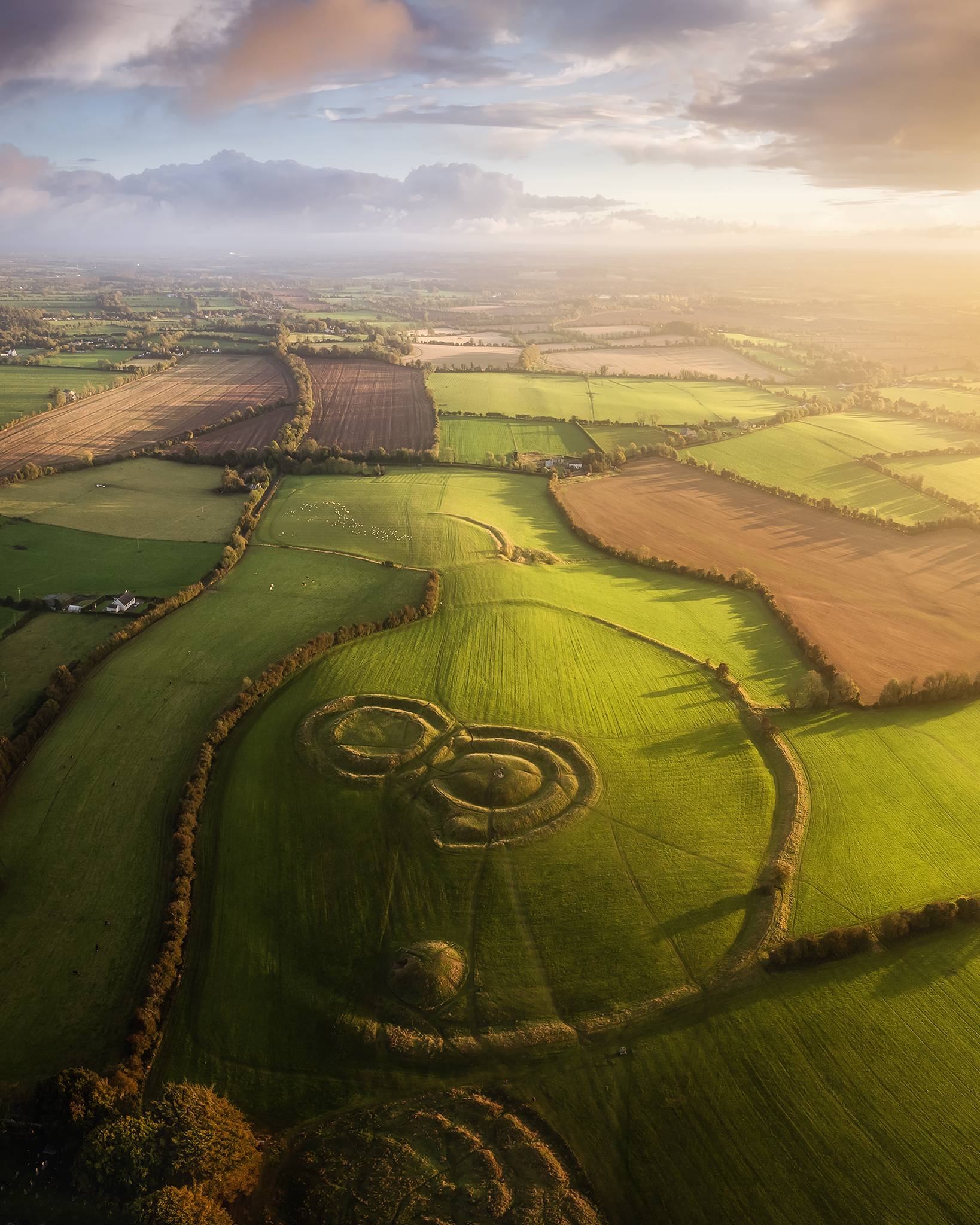
Kevin Flanagan explores the world of Brehon Law and what it can reveal about ancient Irish society. He discusses law without a central state, the relationship between freedom and responsibility, Irish identity, and what ancient legal traditions can teach us about the modern world.
About the Guest
Kevin Flanagan is the founder of Brehon Academy, an online platform dedicated to early Irish law, mythology, and society where he teaches courses on Early Irish Culture and Society, Irish Mythology, and Brehon Laws of Early Ireland. He is also the creator of SPOTLIGHT, a public speaking coaching practice. Kevin holds a bachelor’s degree in Law and Society and a master’s degree in Politics, Philosophy, and Economics.
Interview
Simon Sarevski: What first drew you to Brehon Law, and what does the study of it reveal about the society that created it?
Kevin Flanagan: My path to Brehon Law started long before I ever sat in a lecture hall. I was a child the first time I heard about the old high kings at Tara, and something in those stories took hold and never let go. I was simply mesmerised learning about the old ways, the old stories and mythologies of Ireland.
Ireland, in that early telling, was not a blank space waiting for someone else’s history to begin. It had kings, and courts, and assemblies, and a whole world of custom governing how those kings held and lost their power. The Ireland I was discovering was truly older than history itself, as many mythologies speak of a time before the arrival of Saint Patrick, the day “recorded history” began.
As a young boy, of about 7 or 8 years of age, I began to study history in school. But that first year of “history” was focused entirely on the legends of old Ireland. We were learning exciting stories like Finn and the Salmon of Knowledge, about the plight of the Children of Lir who were magically cursed and transformed into swans for 900 years, or how the boy Setanta became Cú Chullain, the ‘hound of Cullan,’ among many other magical legends. I believed them all. I remember whenever I was near a river or a stream looking for the Salmon of Knowledge, or listening for the wails of the Banshee at night. Imagine my disappointment when, the following year, we began learning real history, and the myths were left on the shelf. Don’t get me wrong, I really enjoyed learning about history, but it didn’t have the same grip on my heart as the myths and legends.
But I grew up, and became a man. Once I opened Lawrence Ginnell’s “The Brehon Laws: A Legal Handbook,” I was hooked. There I was reading about this wonderful, highly advanced and forward-thinking set of guidelines, operating in the absence of state enforcement, and much fairer and kinder than the laws I was brought up with. I remember being completely mind-blown the moment I realised society could be organised in a completely different way, and Ireland was the historical proof of that.
When I went to university as a mature student, I studied law as an undergraduate, and a few years later a Master’s in politics, philosophy and economics, which gave me the tools to go back and read that world properly rather than just admire it from a distance. Later, I found Fergus Kelly’s work and the older legal texts standing behind it; the boyhood fascination with Tara and the early myths turned into something I could actually work with, a legal system that had been functioning for centuries before Saint Patrick, the Vikings, and the Anglo-Norman lords ever landed on these shores. A legal system complete with its own jurists, its own procedures and its own deeply considered ideas about status, contract and compensation. And, dare I say it, a law that was superior to the English Common Law we were left with after colonisation.
What the study reveals about early Irish society is that it was far more legally sophisticated than the “Celtic mist” image suggests. The Brehons were professional jurists trained over years, not druids waving sticks. Contracts were taken seriously enough to have detailed rules on capacity and consent. Status was minutely calibrated, and every relationship, from fosterage to marriage to tenancy, and even beekeeping, had a legal shape. Every possible wrong, duty, and privilege were accounted for.
A society does not produce that kind of detail unless it takes order and fairness seriously, even while it remains, in other respects, a hierarchical and often violent world.
I feel it would be remiss of me not to mention that the old Irish never referred to this as “Brehon law,” as that was English (or Béarla ). They would have called it according to the people it was being applied to, and so, for the free people, the free land-tillers, it was called the Fenechas.
What can the study of ancient institutions reveal about a people that political history alone cannot?
Kevin Flanagan: Political history tends to follow kings, battles and treaties, the events that get recorded because someone with power wanted them recorded. Institutions like law, kinship and land tenure show you how ordinary people actually lived between those events, and that is where the texture of a culture sits.
Brehon Law shows this well. The political history of early Ireland is a long, often repetitive, tragic story of rival kings and shifting overlordships. The legal texts, by contrast, show a settled and remarkably consistent way of handling disputes, protecting the vulnerable through fosterage and sick-maintenance law, and keeping the pieces of daily life, cattle, land, marriage, craft, and function even while kings came and went above it. Political history gives you the weather. Institutions give you the climate.
How would you describe Brehon Law in simple terms, and what made it different from the centralised, state-based systems we know today?
Kevin Flanagan: Brehon Law is best understood as a system of law without a state to enforce it. There was no police force, no royal court handing down sentences, and no single lawgiver. Instead, professional jurists called brehons (a word derived from the Irish breitheamh, simply meaning a ‘judge’)interpreted an inherited body of law, much of it eventually written down in texts like the Senchas Már (among many, many others), and applied it to disputes brought before them by the parties themselves. It had ‘self-executing ’ features, meaning that contracts were formed in such a way that it would be more costly not to fulfil them than vice versa. This was accomplished with an intricate system of pledges.
The core difference from a modern legal system is that Brehon Law was not primarily about the state punishing wrongdoers. It was about restoring balance between people and kin groups. Every person had an honour price based on their status, and most offences, including violence, were resolved through compensation calculated against that honour price rather than through imprisonment. Enforcement rested on kinship obligation and social pressure rather than on a central authority with a monopoly on force. It is closer to a highly formalised system of mediation and restitution than to anything we would call a police-and-prison model today.
Remarkably, for a time when Ireland was ‘stateless,’ it was described as Insular Sanctorum et Doctorum — or the Island of Saints and Scholars. Not bad for a so-called ‘anarchist society,’ right?
Modern law leans on punishment; Brehon Law leaned on compensation and restored relationships. What can modern societies learn, and where might modern justice have lost something?
Kevin Flanagan: Brehon Law treats an offence primarily as an injury to a relationship rather than a debt owed to the state. Restitution went to the victim and their kin, not to a royal treasury, and the process was designed to bring the wronged party back into balance with the wrongdoer rather than to remove the wrongdoer from society. That is the opposite instinct to a prison sentence, which severs the relationship and offers the victim little beyond the satisfaction of punishment.
Modern justice gained enormous benefits from centralisation. A state monopoly on enforcement means punishment does not depend on how strong or numerous your family happens to be, which was a real weakness in the Brehon system. What it lost is the direct link between the wrongdoer and the person they wronged. A modern offender pays a debt to an abstraction called the state, and the victim is often a witness in their own case rather than its center. Restorative justice programmes today are, whether they know it or not, reaching back toward something the Brehons built into the system from the start.
Where should we be careful when looking at Brehon Law through modern eyes?
Kevin Flanagan: The biggest trap is treating early Irish society as gentler or more egalitarian than it was because its law was sophisticated. Brehon Law operated within a strict hierarchy of status, and your honour price, your legal capacity, and even your right to give evidence depended heavily on your rank. Slavery existed, and the law regulated it rather than abolished it. Women had certain protections and property rights that were, in some respects, ahead of what later common law offered, but they were not the equals of men before the law, save in some rare cases where the woman had raised her status/honour price above that of her closest male kin, such as by pursuing one of the skilled arts, like poetry, druidry, or medicine, etc., which they were not precluded from exploring.
The other trap is assuming law meant peace. Cattle raiding, feuding, and inter-tuath (small kin-based kingdoms loosely gathered under provincial overkings) violence were common, and the elaborate compensation system existed precisely because violence was a constant feature of life, not a rare exception the law occasionally had to handle. Brehon Law was a sophisticated answer to a genuinely unstable and unequal world, and it deserves respect on those terms rather than on the terms of a fantasy about a lost golden age.
I suppose the biggest risk of all is trying to judge early Irish society by a purely modern moral lens without first understanding it on its own terms. Slavery was a fact of life across the ancient and medieval world, Ireland included, and for a person captured in a raid it was very often the alternative to death rather than to freedom. That does not make it good, and I am not going to pretend otherwise.
What it does mean is that early Ireland is more interesting, and more useful to study, than a simple story of villains and victims allows. The law drew sharp lines between the enslaved, who held no legal personhood at all, and the far larger population of base clients, who were bound to a lord by land and debt without being anyone’s property. Modern life still runs on versions of that second relationship, dependency without ownership, and that is the comparison worth making, not the first one.
Moving a few hundred years later, did Irish Protestant and Catholic identities diverge through religion, politics, culture or something deeper, and have they become fundamentally different peoples?
Kevin Flanagan: That question reaches into territory I would rather leave alone, since it sits closer to present-day politics and theology than to the law and history that are my own ground. What I can speak to with confidence is the inheritance both traditions on this island share far more deeply than the headlines usually suggest: a common law, a common language, a common mythology, and a shared Christian religion that runs back well over a thousand years before any of the later divisions took hold. That shared root is the story I want to spend my time telling.
Rather than framing the conflict as being one of strictly religious characteristics, I prefer to go further back; to a time when everyone was Catholic. Before the Tudors, before Henry VIII with his unique chop-and-change approach to his marriages; everyone in western Europe was Catholic. So, religion isn’t a good, or even useful, metric or lens for viewing the more recent conflict.
Instead, I tend to argue that it is not so much a clash of religions but a clash of cultures. Mindsets that were simply incompatible.
This can be illustrated quite clearly with two quotes, centuries apart. Sir John Davies wrote the following in a treatise in 1612 titled: A Discoverie of the True Causes Why Ireland Was Never Entirely Subdued [and] Brought Under Obedience of the Crowne of England (a pretty premature title as shortly afterwards the Ulster plantations began and were largely successful):
“For there is no Nation of people under the sunne, that doth love equall and indifferent justice, better then the Irish; or will rest better satisfied with the execution thereof, although it be against themselves; so as they may have the protection and benefit of the Law, when upon iust cause they doe desire it.”
Fast-forward to the 1950s to RW Bentham, a barrister writing on the history of the Bench and Bar in Ireland, who outlines several anecdotes that highlight the drastic shift in attitudes of Irish people towards the laws.
In one such anecdote, Bentham recalls:
“[t]he Irish witness’ reply to Lord Justice Darling when the judge turned sternly to him and said: ‘Tell me, in your country, what happens to a witness who does not tell the truth?’ ‘Begor, me Lord,’ replied the Irishman, with a candour that disarmed all criticism, ‘I think his side usually wins!’”
Bentham then goes on to state:
“This Irish irreverence for law, however, does not stem from sympathy with crime, or wrongdoing in general, but rather from the fact that the Irish, who have a longish memory, are aware even now that the law in Ireland is not Irish law. However just it may be—and it was once most unjust—it does not command reverence as a native institution, but simply respect nowadays as an essential part of the machinery of government.”
These two quotes illustrate just how far the old Irish drifted from a system of native law that was characteristically their own to being suspicious of and irreverent towards the laws of Bentham’s time. Which, Bentham is quite prescient to point out, the Irish knew deep down were not truly Irish laws, not theirs, not native. Between these two pillars, the conflict, the troubles, and the whole mess that goes with it can be better understood more so as a clash of cultures, of legal systems, and ultimately of mindsets that were incompatible from the start.
Moving further into Irish history, how should we understand the long-term impact of the Great Hunger on Irish identity and nationalism?
Kevin Flanagan: The Great Hunger (an Gorta Mor), 1845 to 1852, reshaped Ireland at a scale that is hard to overstate. The population fell by roughly a quarter through death and emigration within those few years, and emigration continued as a settled feature of Irish life for the following century. That alone changed the shape of the nation, since the diaspora it created in America, Britain and Australia became a permanent extension of Irish identity, one that later fed money, arms and political pressure back into the independence movement.
It was one of several famines to strike Ireland over the centuries, and not even the deadliest by proportion. Between 1740 and 1741, a lesser-known catastrophe called Bliain an Áir, the Year of Slaughter, killed a greater share of the population than the potato blight ever did. The transatlantic passenger routes that carried a million Irish people out of the country a century later barely existed in 1740, so for most people escape was never really on the table, and the dying happened at home rather than at sea or on foreign shores.
Politically, the Great Hunger of the 1840s hardened a narrative of British neglect that fed directly into the nationalism of the following decades. The degree of British culpability, whether it was catastrophic policy failure, ideological rigidity around free trade and relief, or something closer to deliberate indifference, is still debated among historians, and I would not claim the matter is settled.
A growing number of Irish people I talk to, on my page and off it, have started rejecting the word ‘famine’ altogether and calling it a genocide instead. I understand the instinct. Ireland has some of the most fertile land in Europe, and it adds real insult to injury to learn that grain and livestock continued to leave Irish ports for British markets throughout the worst years, even as people starved within sight of the docks.
Whether that amounts to genocide in the strict legal sense, a deliberate intent to destroy a people, is a question historians and linguists still argue over, and I won’t pretend it is settled. What isn’t in dispute is that British policy turned a crop failure into a mass death event through ideological rigidity, utter blind ignorance, and a refusal to intervene, and that a country capable of feeding itself was allowed to starve instead.
What is not in serious dispute is that the Great Hunger became the emotional core of a story Irish nationalism told about itself for generations afterwards, and that the diaspora it created gave that story a global audience it would never otherwise have had.
Moving into the twentieth century, how should outsiders understand the Troubles, why did the conflict emerge, and what can be learned from the peace process?
Kevin Flanagan: The Troubles grew out of a Northern Ireland state that, from the partition in 1921, was built with a permanent unionist majority and, for its first half-century, ran systems of housing, employment and electoral boundaries that disadvantaged the Catholic minority. The Civil Rights movement of the late 1960s, modelled explicitly on its American counterpart, demanded an end to that discrimination through peaceful protest, and the violent state and loyalist response to those protests is generally treated by historians as the spark that tipped the situation into three decades of armed conflict involving republican paramilitaries, loyalist paramilitaries and the British state.
The lesson most consistently drawn from the peace process is that a conflict rooted in identity and constitutional status is rarely resolved by military victory, and that progress came once all sides accepted a framework built on consent, power-sharing and the decommissioning of weapons rather than on any side achieving its maximal aim. That is a slower and less satisfying kind of resolution than outright victory, but it is the one that actually produced almost three decades without large-scale violence.
Was the initial partition of Ireland inevitable, and could a different arrangement realistically have worked?
Kevin Flanagan: Ireland was never a single, unified political entity for any real stretch of its history. Depending on the period, the island was made up of somewhere between a hundred and a hundred and fifty tuatha that traded, negotiated and intermarried with each other about as often as they raided and fought. Often the boundaries of these kingdoms or clan groups were determined by the natural landscape, the rivers, streams, mountains and forests.
That long-standing fragmentation is one major factor in why the Vikings, and later the Anglo-Normans, the English, and ultimately the British found Ireland so much easier to gain a foothold in than a genuinely unified kingdom would have been. There was rarely one authority to defeat, only a great many separate lords who could be outmanoeuvred, allied with or played off against each other one at a time. Despite the ease at which all these invading forces took hold of parts of the island, it was this fragmented nature of the landscape that enabled Ireland and Irish people to resist complete domination for so long. A case in point is the Case of Tanistry (1608), but that discussion would be too long for this piece. For those interested, I discuss the case in a video on my Brehon Academy YouTube channel.
Whether that same pattern says anything definite about partition specifically, or whether a different arrangement in 1920 could have held, is a question I will leave to historians of that period. My own interest is in how far back the fragmentation goes, and what it tells us about the kind of polity early Ireland actually was, long before anyone was drawing state borders on a map.
Broadly, what can ancient Irish legal traditions teach modern people about freedom, responsibility and community?
Kevin Flanagan: Brehon Law never separated freedom from obligation the way a lot of modern political language does. Your rights as a free person came bundled with duties toward your kin group, your lord and your community, and status itself was partly a measure of how well you discharged those duties, not simply a title you held. Freedom in that world was not the absence of obligation. It was the capacity to meet your obligations on your own terms rather than someone else’s. This inverts the modern conception of individual freedom on its head. The old Irish knew, inherently, that rights (freedoms) simply could not be severed from duties (responsibilities).
There is a real lesson in that for a modern audience used to thinking about rights and duties as separate, sometimes competing, categories. The Brehon system suggests that a community stays functional not because everyone is left alone to do as they please, but because freedom and responsibility are treated as two sides of the same legal fact. A person’s standing in the community was earned through the honouring of debts, contracts and kin obligations, and that standing is what protected their freedom in turn.
What is one thing about Ireland that outsiders most often misunderstand?
Kevin Flanagan: Most outsiders arrive with a version of Ireland built from shamrocks, leprechauns and rolling green hills, and that image, however charming, flattens a culture that produced one of early medieval Europe’s most sophisticated legal systems, a manuscript tradition stretching back over a thousand years, and a body of mythology as intellectually serious as anything from Greece or Scandinavia.
The deeper misunderstanding sits underneath that one. People often assume Irish history begins with English involvement, as though nothing of substance existed on the island before Strongbow or Cromwell. Early Ireland had its own kings, its own jurists, its own scholars and its own highly developed sense of law and society for centuries before any of that. The story of colonisation is a real and important part of Irish history, but it is not the first chapter, and treating it as the first chapter erases everything the Brehons, the poets and the monastic scholars built before it.
For a real life example, when I am showing tourists around Dublin as a tour guide, I am always at pains to point this out. There is more to Ireland than plastic leprechauns, green Guinnesses, and kiss-me-I’m-Irish t-shirts. Ireland, and Irish people, have contributed a lot to the history of the world. Even the spaces you see between these words were an invention of Irish monks c.600 AD.
What books or resources would you recommend for someone who wants to explore these themes further?
Kevin Flanagan: For Brehon Law itself, Fergus Kelly’s A Guide to Early Irish Law is the essential starting point, and his Early Irish Farming takes the same rigour into the economic side of that world. D.A. Binchy’s Corpus Iuris Hibernici is the foundational scholarly edition of the legal texts themselves, though it is dense going without some grounding first. T.M. Charles-Edwards has written extensively (Early Irish and Welsh Kinship) on early Irish kinship and society and is well worth following once the basics are in place.
For mythology, Cecile O’Rahilly’s translations of the Táin Bó Cúailnge are the standard scholarly access point, and the Lebor Gabála Érenn is essential for the mythological history the Irish told about themselves. Also, Jim Fitzpatrick has produced a gorgeously illustrated collection of books based on the old tales from the Lebor Gabála Érenn if people want a more enjoyable and less academic entry point into the old sagas.
If you would rather come at all of this through story and structured courses than through a stack of academic texts, that is exactly what I built Brehon Academy to do. It is the bridge I wished existed when I started.
And, to end on a familiar note for regular readers, how do you find freedom in an unfree world?
Kevin Flanagan: Brehon Law offers a useful reframe here. It never imagined freedom as the absence of constraint. It imagined it as a position you held within a web of obligations, to your kin, your lord, your community, that you honoured well enough to keep your standing and your independence intact. A person with no obligations in that world was not free. They were without protection, without status and without a place.
I think that holds up outside early Ireland too. Freedom in an unfree world rarely comes from escaping every constraint, since most of us cannot do that and most of the constraints that matter — family, work, community — are not the ones worth escaping anyway. It comes from choosing which obligations you carry and carrying them well enough that your standing among the people who matter to you is secure. That is not the freedom of having no ties. It is the freedom of having chosen yours.