
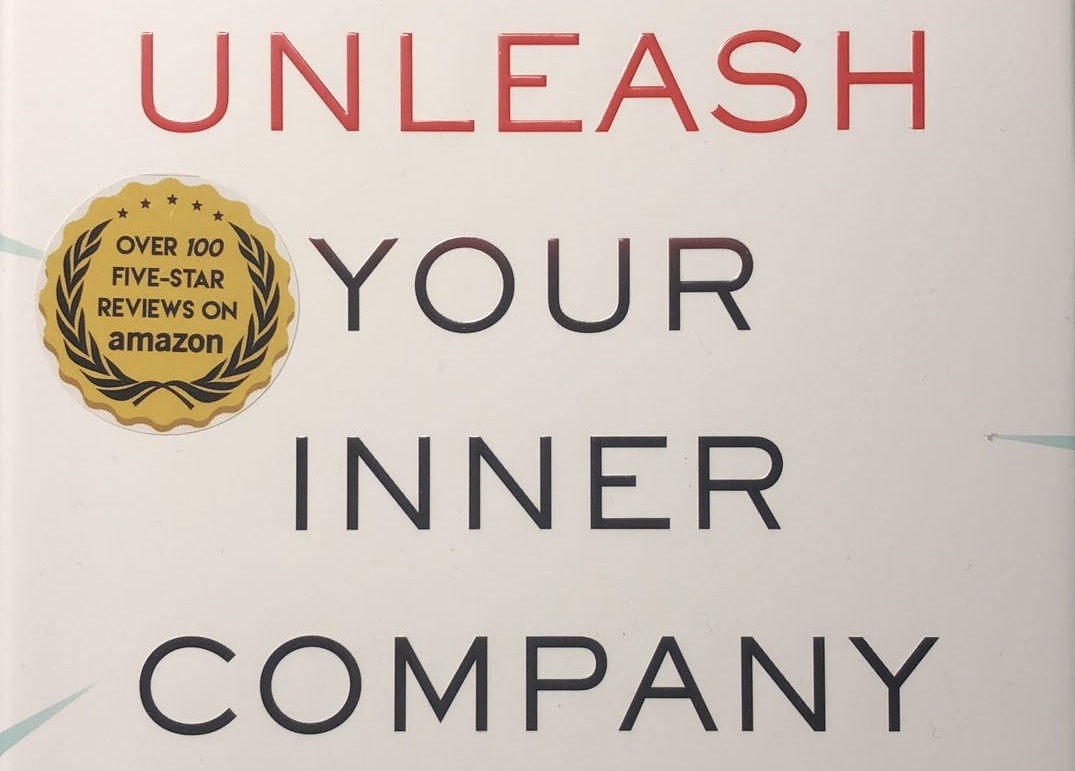
What does it mean to “unleash your inner company”? For entrepreneur and author John Chisholm, entrepreneurship is not simply about starting a business, but about discovering where your skills, resources, and ambitions can create something of value.
About the Guest
John Chisholm is a serial entrepreneur and public intellectual. He is the author of Unleash Your Inner Company, the thinking man’s guide to entrepreneurship. A frequent contributor to the Wall Street Journal and Forbes, he writes on law, innovation, technology, economics, and regulation. He sits on the boards of the Santa Fe Institute, the Foundation for Economic Education, and the Future of Free Speech.
Interview
Simon Sarevski: You titled your book Unleash Your Inner Company. What does it mean to think of yourself as a company rather than an employee?
John Chisholm: Unleash Your Inner Company doesn’t mean for you to think of yourself as a company. Rather, it calls on you to awaken and unleash the future startup inside your heart, soul, and mind that is waiting to escape and be turned into a reality. The book takes you through a step-by-step process to do just that.
Your book is known to bring fresh perspectives to all aspects of entrepreneurship and life. What is one example?
People accept and have internalized the importance of passion in starting new ventures, but today, that’s old news. Some books add the importance of perseverance; the combination of passion and perseverance — often called “grit” — is more interesting. But no one is talking about how passion – an attitude — and perseverance – a behavior — reinforce each other, forming a positive feedback loop. Wherever you see exceptional performance in any realm of life —from art to sports to academics to entrepreneurship—such feedback loops are at work. Viewed this way, our attitudes and behaviors become levers we can use to build any desired aspect of character, including courage, honesty, or integrity, that we wish.
What is one misconception that people have before starting their own company, or idea from Unleash Your Inner Company that readers initially resist but later realize is true?
John Chisholm: Many folks come to entrepreneurship with the idea that the first thing they need to do is raise money. This mindset can work for extremely experienced entrepreneurs with proven track records of success. It is not the case for most, especially first-time entrepreneurs. That most entrepreneurs’ attempts to raise money are unsuccessful is evidence of this. Much work needs to be done before you are ready to raise money, including pinpointing and validating the human need and customer set you are addressing, inventorying your resources and ensuring a good fit between them and your addressed customer need, confirming solution-market fit, and achieving some market traction, however early and limited it may be. Out of 26 chapters in the book, the chapter “Don’t Waste Time Raising Money” is chapter 23, close to the end, for a reason. There I discuss the best times to raise money: when you have achieved milestones that either significantly reduce investor risk, increase your firm’s upside potential, or ideally both. The chapter also addresses how to fund your business in the interim until you are ready to raise money. Following this guidance will let you make a positive first impression with investors, put you in a stronger negotiating position, and ultimately save you time fundraising.
People often point to university dropouts like Zuckerberg, Jobs, and Gates as examples of entrepreneurial success. But most people don’t have wealthy parents, elite networks, or a billion-dollar idea. Should an average, middle-class student still aspire to entrepreneurship?
John Chisholm: I was the first male in my family to get a bachelor’s degree, and my high school guidance counselor discouraged me from applying to MIT. From my tiny high school in Florida, getting in seemed utterly impossible. Even my dad expected me to go to Palm Beach Junior College. So, I can relate to your question. Despite your examples, very successful college dropouts are rare. Most successful entrepreneurs are college educated but much less visible than the ones you listed. So, choose a college major for which there is market demand and don’t drop out. Gain relevant work experience after graduation. Most entrepreneurs are at least in their 40s by the time their ventures enjoy success.
Getting my second company, CustomerSat, through the dot-com bust of 2000-2001 was the hardest thing I have ever done. But it was also the year of my life in which I learned the most about startups, business, and life and added the most value to myself. Entrepreneurship is not easy, but you can do it.
In choosing a college major, whether you aspire to entrepreneurship or not, consider the supply and demand for graduates with that knowledge and skill set. If supply exceeds demand — as it generally does for humanities, gender studies, fine arts, and anthropology — you may face unemployment or only low-wage job options after graduation. If demand exceeds supply — as it generally does for data science, nursing, computer science, and chemical engineering — you will likely enjoy strong demand for your knowledge and skills, and more opportunities for on-the-job learning that will benefit your future venture.
Here is an inspiring point: assuming you learn from each experience, every new venture that you start is more likely to succeed than the previous one. Let’s say that your first venture has only a 30% chance of success. Your second venture might have a 50% chance; your third venture, 70%; and your fourth venture, 85%. The probability that at least one of these four ventures is successful is over 98%.
Technology has dramatically lowered both the cost of starting a business and the barriers for everyone else, making competition fiercer than ever. Why should someone choose the uncertainty of entrepreneurship over a stable, well-paid career?
John Chisholm: Yes, as platforms have become more powerful, a software project that would have required a team of a dozen developers in 1996 might have required half that many by 2016 and only one developer today. And yes, the barriers to your competitors are lower than ever. At the same time, no one else in the world has your unique combination of skills and other resources, and the number of human needs far exceeds the eight billion people on earth, so there are almost certainly some human needs for which you are the very best person on earth to satisfy. In chapter 6 of Unleash Your Inner Company, I present a tool to inventory all the resources at your disposal: your STARS chart. “STARS” refers to your Skills, Technologies, Assets, Accomplishments, Relationships, Reputation, and (inner) Strengths.
Why choose entrepreneurship over a stable, well-paid career? Here are just two satisfactions that entrepreneurship can impart that you won’t find elsewhere: the realization you have created something 1) that will survive on its own, even without your continued involvement, if you wish; and 2) that has real value that others want to invest in or acquire.
How are AI and technological change reshaping what “career” means today?
John Chisholm: First, in the past, it has often taken years for young professionals to advance from individual contributor to manager. Acquiring domain knowledge, management skills, and interpersonal skills takes time. Today, we are all managers from the outset, with AIs being our direct reports, who not only perform tasks for us but who train us, accelerating our acquisition of domain knowledge. Interpersonal skills may be less important with AI than with humans, but management skills now take on heightened importance: setting clear objectives, delegation, communications, and coordination with AIs.
Second, familiar named disciplines — such as art history, aviation, chemical engineering, nursing, or urban planning — are not distinct bodies of craft and knowledge but subsets of an all-encompassing space that spans all disciplines, whose lines of demarcation are becoming ever fuzzier. Only a small part of this huge space has yet been discovered by anyone. Over time, the paths each of us traverses through this space will increasingly be unique, less bounded by standard curricula in high school and college, and increasingly self-driven. Curiosity may well become the human quality most correlated with success. Curiosity informs action, and the most successful will be those whose paths extend most deeply and widely into this space.
Artificial Intelligence is creating enormous opportunities, and at the same time, anxiety. Do you see it primarily as a tool of empowerment or of disruption and risk?
John Chisholm: Throughout history, technologies that provide new functionality, have multiple applications, and make capabilities more broadly available than previously — ranging from printing and the camera to recorded sound, motion pictures, and the automobile — follow predictable panic cycles in which public concern reaches peaks of hysteria before retreating to public acceptance. Today we can clearly see how profoundly all of those technologies have empowered humanity.
AI is following the same path. Thanks to media selection effects (risks attract “eyeballs”) and the availability heuristic (we more rapidly and strongly recall downside than upside events), AI risks and downsides attract more attention and are more memorable and viscerally impactful than its myriad benefits and upsides. I don’t at all dismiss AI risks, but to do a fair assessment of AI, we must be sensitive to this asymmetry when identifying, quantifying, and weighing its costs and benefits. As AI becomes more widely and seamlessly integrated into our everyday lives and taken for granted, I believe people will view the technology very favorably.
Is entrepreneurship something people must be born for, or can anyone become an entrepreneur?
John Chisholm: I had a great advantage starting my first company: I was fired from my previous job. While interviewing for a new position, I had a chance to consult in product management, the field I was working in. I did that, learned some new things, made some money, and went back to job interviews. Then another consulting assignment. Then back to interviews. Then another assignment and another. Eventually I quit interviewing for a job and became a consultant. I evolved my first company, Decisive Technology, the first to automate online surveys, out of that consulting practice. Given this roundabout path, I don’t think you could say I was born to be an entrepreneur. Rather, I gradually evolved into one.
12,000 years ago, before the invention of agriculture, all of us were hunter-gatherers; all of us were entrepreneurial then, or else we didn’t survive. Today, we have many more, less stressful options, including working for established companies and receiving regular paychecks. But if those options suddenly went away and we had to create our own jobs, most of us today could do it, however challenging it might be.
—— Related: Per Bylund on entrepreneurship and progress ——
At what point should someone abandon a failing venture instead of persisting?
John Chisholm: Speaking broadly, I think we most often err on the side of giving up too quickly rather than persisting for too long. After the dot-com bust of 2000-2001, it was another seven years before CustomerSat, my second company, was successfully acquired. Many other management teams just gave up and threw in the towel before then.
If a venture fails to gain traction, often it is because the entrepreneur hasn’t stuck closely enough to a real, unsatisfied customer need. We usually think about scaling ventures up, but if the customer need we are attempting to address spreads our resources and competitive advantage too thinly, that customer need and our venture may need to be focused, that is, scaled down. Instead of attempting to serve an entire country or an entire industry, for which cities in that country or companies in that industry does your solution have the most value? To achieve profitability, you might need to focus and scale down to serving just a single city or company. Once you have done so, new directions for you to again upscale your business will likely appear. Be open to what you discover as you pivot; the new businesses to which these directions lead you may be very different from the business you originally founded.
How can my start-up effectively compete with well-established incumbents many times its size?
John Chisholm: By being different rather than trying to be better. When I say “different,” I mean using a different approach, design, or technology, or addressing a different customer need, than do well-established incumbents, so you are not competing with them directly. Your product or service may not be the best choice for most or even many customers; but make certain it is the best choice for some group of customers. As those customers tell their friends and colleagues about your product, and buy from you again, you will grow with them. Being different gives you time and space to get established even in the shadow of well-established incumbents.
Your book isn’t only about building companies; it’s about building a life. What does success look like if your goal isn’t becoming a billionaire?
John Chisholm: Unleash Your Inner Company lays out a ten-step, purpose-driven process to discover, launch, and scale up your ideal business, starting by finding unsatisfied customer needs in areas you are passionate about. We then use your STARS Chart to assess the fit between you and each of those needs that you might satisfy, and to see where you have the strongest advantages over others who might address similar needs. It is then an iterative process to refine both the needs and your STARS and narrow down to the one best fit.
The same process can be used to choose a path in life that fits your passions and strengths and for which you have the most natural advantages. But instead of starting with different customer needs, we start with different professions or careers, whose provided services are the needs you will satisfy. We then assess each profession’s fit with your passions and STARS, refine the focus of each professional option, as needed; and finally narrow it down to the one option with the best fit for you.
Throughout history, what conditions have most consistently produced flourishing economies and entrepreneurship?
John Chisholm: Drawing on the work of Nobel Prize–winning economists such as Douglass North, Daron Acemoglu, and James Robinson, secure property rights, constraints on rulers’ ability to seize them, and predictable rule of law more generally are the catalysts for flourishing societies and economies. Rule of law is important not just for protection from the state, but for enforcing contracts between private parties, so strangers can trade and invest without relying on kinship or personal relationships. Historical bursts of prosperity often coincide with new trade routes and media of exchange.
It is impossible to know very far in advance what innovations entrepreneurs will bring to market — if we could, we wouldn’t have to wait for entrepreneurs to develop them — the innovations would already be here! Given that, it is hard to improve upon freedom, both personal and economic, as the essential enablers of entrepreneurship. Drones could be all around us, painting buildings, washing skyscraper windows, and picking up trash. Why aren’t they performing those useful tasks? Because draconian regulations from the Federal Aviation Administration preclude commercial use of drones in many everyday circumstances. Having started companies over three decades, I can say that the biggest challenge to scaling up a startup today is not generally technological or financial but regulatory compliance in all its myriad forms. Alas, there is no one silver regulatory bullet, more like thousands of tiny regulatory “beetles” that steal entrepreneurs’ time, attention, and resources from their essential mission of satisfying customer needs. This is a problem of our own making. In Appendix E of Unleash Your Inner Company, I offer a range of suggestions for doing just that, such as making each regulation as local and bounded as possible, capping the number of words and pages of each regulation, and ensuring that every regulation sunsets after some number of years.
—— Related: Kristian Niemietz on why Britain stopped building ——
Which books have most influenced your thinking on entrepreneurship and innovation, and which would you recommend to readers who want to understand those ideas today?
John Chisholm: I don’t read much fiction, but the novel Atlas Shrugged by Ayn Rand tremendously inspired me when I first read it in high school. I still recommend it today. It may well be the reason I became an entrepreneur. In non-fiction, my favorite authors tend to be science writers like Richard Dawkins’ The Selfish Gene, Matt Ridley’s The Rational Optimist, and Brian Arthur’s The Nature of Technology. Early on in my career, I discovered Dale Carnegie’s How to Win Friends and Influence People and took the course based on it, which gave rise to much of today’s human potential movement. Its leadership and human relations principles apply every day of your life. Despite being available to anyone at modest cost, its flagship course may well be the most valuable training I have ever taken.
Finally, how do you find freedom in an unfree world?
John Chisholm: How much freedom an individual has in the world depends not just upon the world around the individual, but upon both the world and the individual. Both the world and one’s own courage can either enable or restrict thoughts, words, and actions. The more courageous we are, the fewer restrictions we feel. I’m not as courageous as I aspire to be, but I’m sufficiently courageous that I don’t feel unfree. So creating freedom for oneself has two levers: making the world around us freer and building one’s own courage. To make the world freer, I have already mentioned Appendix E of Unleash Your Inner Company with techniques for making the modern regulatory state more resilient, humane, and friendly to startups and innovation. Similarly, Chapter 12 discusses how to build courage, in part by behaving courageously — pretending, at first, if necessary — as if you already embody that quality. I grew into finding freedom, one choice at a time. That’s my hope for everyone reading this, too.