
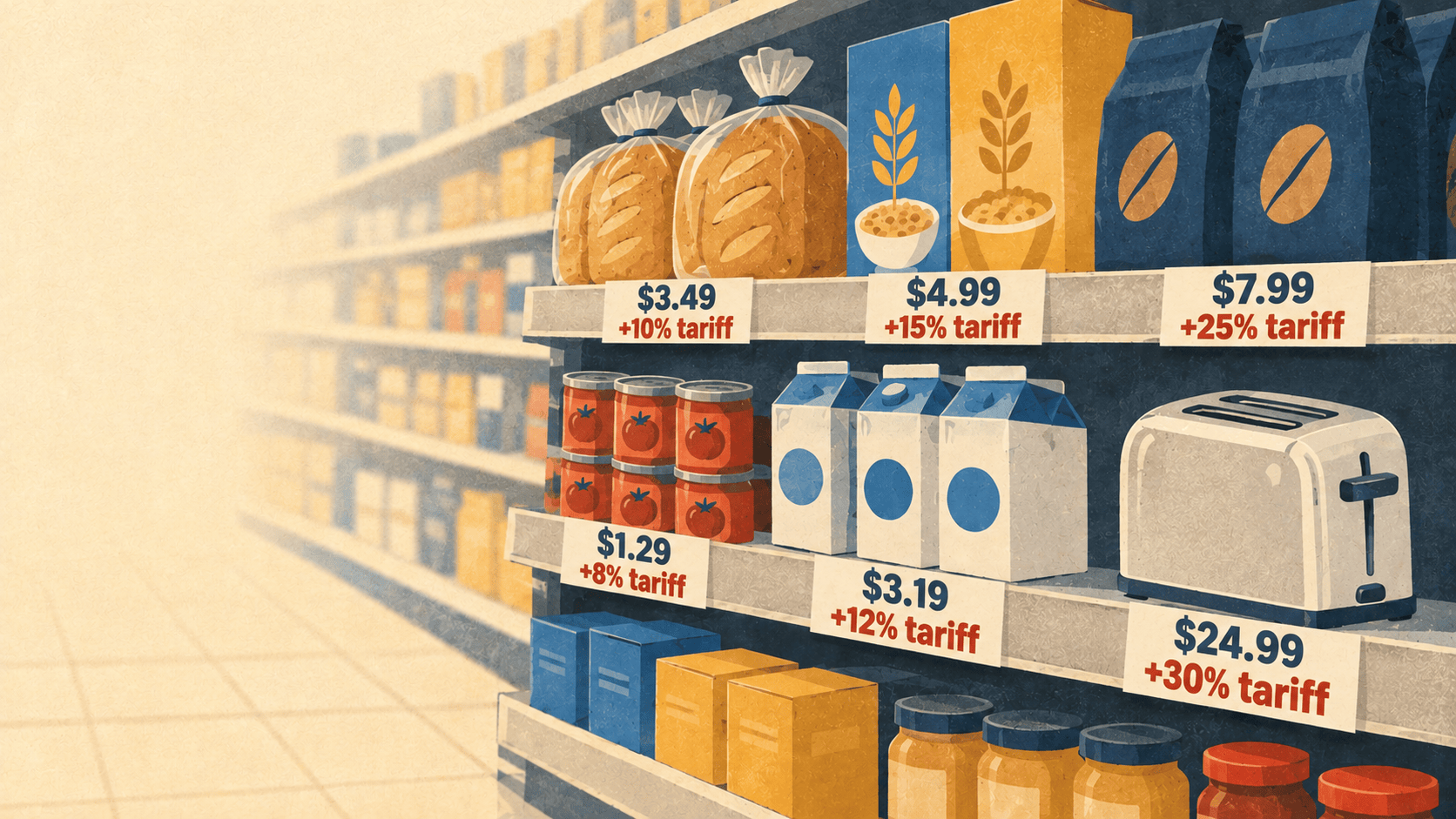
Retaliatory tariffs are back, and so is the argument that hitting back will make other countries change course. Vincent Geloso explains why retaliatory tariffs fail, why protectionism keeps returning, and why free traders may need to “buy out” the protectionists.
About the Guest
Vincent Geloso is Associate Professor of Economics at George Mason University and Senior Economist at the Montreal Economic Institute. He is the author of Rethinking Canadian Economic Growth and Development since 1900.
Interview
Simon Sarevski: Over the past fifty years, the nature of work has changed dramatically: we produce more industrial output with fewer workers, while many traditional jobs and the communities built around them have declined. I see Trump as a symptom of this broader economic and social backlash rather than its cause. Am I right, or am I missing something?
Vincent Geloso: You’re missing something. We produce more manufacturing output with fewer workers, which means that productivity must have increased. This is already a good thing because it means higher incomes. But, more importantly, it means that capital and labor are freed for other sectors: health care, research, education, electronics, etc. This is known as “Schumpeterian” growth because some old sectors contract in relative size (or absolute size), freeing resources for new ones. The result is general uplifting.
However, and here comes the rub, the adjustment can be difficult. Technological change driving down some industries and boosting others does not mean that workers and capital adjust overnight. This is where there is always room for populist economics to rise. The one thing I will add is that this room is not some fixed quantity. It is generally made greater by bad government policies that make it harder for people to adjust or that prune the benefits of technological changes.
For example, automation in the United States did cause problems in terms of income mobility across generations. However, the effect of being born in areas more exposed to automation is entirely conditional on the degree of occupational licensing (e.g., having to acquire a license to braid or repair heating systems) that makes it hard for people to move between industries. Thus, the automation did cause backlash, but this was only activated by government interventions in markets.
——— Related: Art Carden on Prosperity ———
During the 2016 campaign, “learn to code” became a dismissive way of telling displaced workers to adapt. Technological change has created genuine losers, and their political backlash is real. What should a liberal economic order actually do for them?
Vincent Geloso: Let markets open and contestable! We cannot plan how people adjust to changes and how they benefit from technological change. Meddling in the process often does more harm than good as the above example of automation suggests. While I personally favor some redistributive endeavors (e.g., I am conditionally open to basic income schemes as outlined by Charles Murray or Milton Friedman), I think a “First, Do No Harm” approach is needed.
Let us identify all the policies that make adjustments harder and that cut the benefits of innovation from seeping to everyone. In addition to the occupational licensing example, I would point to land use regulation that limit the housing supply in cities and thus lock people away from the high-opportunity zones they are. You can add to this the role of tariffs (which are immensely regressive), regulatory barriers to entrepreneurship (e.g., think all the ridiculous regulations to become a street food vendor or open a coffeehouse). First, do no harm!
Trump has made “retaliatory tariffs” a trending term in 2026. If one country imposes tariffs on your exports, what is the case for imposing tariffs of your own in response?
Vincent Geloso: There is no case! A tariff is a tax, and raising a tax in response to a tax is like ablating your own reproductive organs to spite your ex somehow.
The more sophisticated argument for tariffs states that a large country can sometimes use its market power to improve its terms of trade. How seriously should we take that argument, and what are the political and institutional dangers of giving governments the power to pursue it?
Vincent Geloso: Now, you could plausibly argue there would be one to enact policy influence. But that is a dubious proposition. In the first Trump administration, China did retaliate in ways to influence midterm elections, and a paper in the American Economic Journal found that it may have flipped more than a dozen seats in the House to the Democrats. That seems big, but it is ridiculously small in fact. China is a huge country, and it could do was a dozen seats? And those dozen seats did not buck the President’s policy anyway. So, basically, nada, niet, nothing!
Imagine if you’re a small economy like Canada. The best course of action is patience. Tariffs hurt, but they hurt he who enacts them too. And that means electoral backlash. And the reality is that every big tariff hike in US history was followed by a backlash at elections. Waiting is a weapon. It is the only one as well.
Economists have a fairly clear consensus about what trade deficits do and do not tell us. Why, then, do policymakers, who are generally highly educated, continue to make them such a central part of the case for protectionism? Is it really as simple as political incentives and votes?
Vincent Geloso: Because tariffs have concentrated benefits and diffuse costs. Imagine the cost of a tariff is a billion dollar. Spread over all Americans, it’s a drop in a bucket. If all the benefits, say they amount to 100 million, go to a single firm, then that firm has a huge incentive to push for it. In congressional dealings, this can be roped into a bigger bill to induce a congressman to vote for it. And then, voilà, you have a tariff.
The diffuse costs also create a problem of mobilizing to push against them since, for such a small per-head amount, many might not even be fully aware of the harm. And if they are, why spend time and resources fighting against the tariff?
——— Related: Eamonn Butler on the Case for Free Trade ———
If the objective of retaliatory tariffs is not simply to punish another country, what exactly are they supposed to achieve? Under what circumstances can retaliation actually produce a change in the policies that prompted it?
Vincent Geloso: It doesn’t! In a recent paper with the Montreal Economic Institute, I summarized the economic history literature on one of the most aggressive retaliatory responses to tariffs: Canada’s reply to the Smoot-Hawley bill in 1930. Canada’s retaliatory tariffs during the 1930s were gigantic. But they failed to alter American protectionist policies while aggravating the economic costs of the Great Depression. Canada only secured a return to lower tariffs once President Hoover – he who enacted tariffs – was voted out of office and was replaced by an administration more inclined towards free trade.
For most of the postwar period, the world moved toward a system of negotiated trade liberalization and increasingly rules-based commerce. We now seem to be moving in a different direction. What kind of new world order is emerging in its place?
Vincent Geloso: You say that, but that is a bit of being prey to propaganda from politicians who want to be seen as some form of great internationalists – and maybe win Nobel peace prizes like Cordell Hull did. But the reality is that the majority of trade liberalizations in the postwar period occurred unilaterally and was mostly driven by developing countries. Yes, multilateral and bilateral liberalizations did happen, but unilateral liberalization had the lion’s share.
That being said, yes, we are moving towards greater protectionism. That is bad. But I will not speculate on the politics of it all. I will only reiterate the key point that the big protectionist turn of 1929 and the trade wars that followed only deepened the Great Depression and made the rise of totalitarian and authoritarian governments easier. This is what should worry us most – that protectionism and the economic mayhem it causes opens the door to costly populist leaders (or worse).
——— Related: Johan Norberg on Progress and Globalization ———
One of the classic public-choice problems with tariffs is that protectionism creates powerful interests in maintaining it. Does temporary protection historically tend to become permanent?
Vincent Geloso: Yes, if only because it is difficult to mobilize interest against them (diffused costs versus concentrated benefits). In fact, the most perverse example is that of anti-dumping laws, which are presented as “protectionist tools” to secure freer trade. But, ultimately, they persisted, and the tools became the feature.
The textbook case for tariffs has traditionally been protecting domestic industries, with national security and strategic industries providing one of the strongest arguments. Since COVID, “supply-chain resilience” has become a more prominent justification. Is it a reasonable way to think about trade policy, or a politically convenient way of making protectionism more acceptable?
Vincent Geloso: No, it is not. Because this is like looking at a ledger and looking only at the benefits column. Yes, maybe protectionism makes nations more secure in some way (I doubt it). So, on the national security ledger, that would be (again, I doubt whether its tangible and real) the benefit.
But we have to account for costs! And what are the costs? Tariffs and trade barriers make nations poorer. And no nation is well served in terms of national security by being poor. Wealthier nations have more resources. Resources that can be marshalled to deter aggression and invest in superior defense equipment. All the “national security” malarkey-makers never mention the costs. They just wave their hands and say, like professional hucksters, “do not look at the costs, look at this shiny benefit,” which may or may not exist.
Stepping back from tariffs themselves, what does their resurgence tell us about the relationship between economics, politics, and institutions? Are we simply seeing the unwinding of a particular postwar policy consensus, or does the return of protectionism expose a deeper problem with the political sustainability of economic openness?
Vincent Geloso: I am the wrong person to ask. I am an economist. I am an economic historian. Because of both, more often than not, I see these claims of “policy consensus” as merely the elucubrations of pundits and politicians. They rarely have substance behind the veil.
The interesting part is that I am reminded of a paper by Nobel laureate Joel Mokyr and my GMU colleague John Nye on the bargaining for policy in Britain during the Industrial Revolution. They have this wonderful article in the Southern Economic Journal explaining that “Free Trade Britain” was not some form of pure enlightenment for free trade and commerce where the entire public accepted the economics of specialization and trade. While free traders like Cobden and Bright convinced many, they could not have done it without something extra. British landed elites did not suddenly become disinterested champions of economic liberalism. They benefited from industrialization through rising land values, mineral resources, and urban development, while retaining political influence and protections for their agricultural interests. The bargains over liberalizations (and other things) essentially “bought” their acquiescence. In other words, they were willing to accommodate economic change via liberalization. Liberalization emerged through an imperfect political bargain where protectionists were “bought out.”
This is what I see today. What people call “consensus” is basically saying that “some groups need to be bought” to support free trade. I don’t know which way forward, but free traders need to find a way to buy out the protectionists before too much harm happens.
Since Smith and Ricardo, economists have been making the case for the gains from trade, yet protectionism keeps returning like a cat with nine lives. What have economists failed to understand about the political appeal of protectionism?
Vincent Geloso: Nothing. Everything I said above is commonly accepted within the economics profession (except maybe my point about “buying out” protectionists). Pedagogy is often a task of reiteration. And that means repeating. And, in some cases, offering inducement is necessary. This could mean compensating losers of liberalization with some transitory programs. It could also mean structuring tariff reductions as part of broader policy packages that are “take all or take none.” For example, this would mean pairing cost-reducing deregulations and tax cuts (which business might love) with tariff removals (which business might mildly dislike but prefer to the absence of deregulation or tax cuts).
If the case for economic openness needs a stronger intellectual defense for the 21st century, what should that defense look like? How do you make the case for free trade in a political environment very different from the one in which the postwar consensus was built?
Vincent Geloso: I think my answer above is clear. Buy. The. Protectionists. Out! If free trade produces greater benefits than losses, use some of the benefits to pay the losers. This will discourage them from blocking reforms. The challenge is making whatever bargain reached credible and definitely transitional (we cannot substitute permanent tariffs for permanent subsidies). Maybe a bit of coaxing by convincing the wider public about free trade might help. Protectionists who fear losing their privileges altogether may be more willing to accept partial (incomplete) compensation for surrendering them. Intellectual persuasion is a complement to political bargaining here.
For those wanting to go beyond the headlines and understand the economic and political arguments around trade and economic openness, what books would you recommend they read?
Vincent Geloso: Anything by Douglas Irwin (Peddling Protectionism, Clashing Over Commerce, Against the Tide) or historical work on mercantilism such as Politicized Economies by Robert Ekelund and Robert Tollison or Mercantilism by Lars Magnusson.