
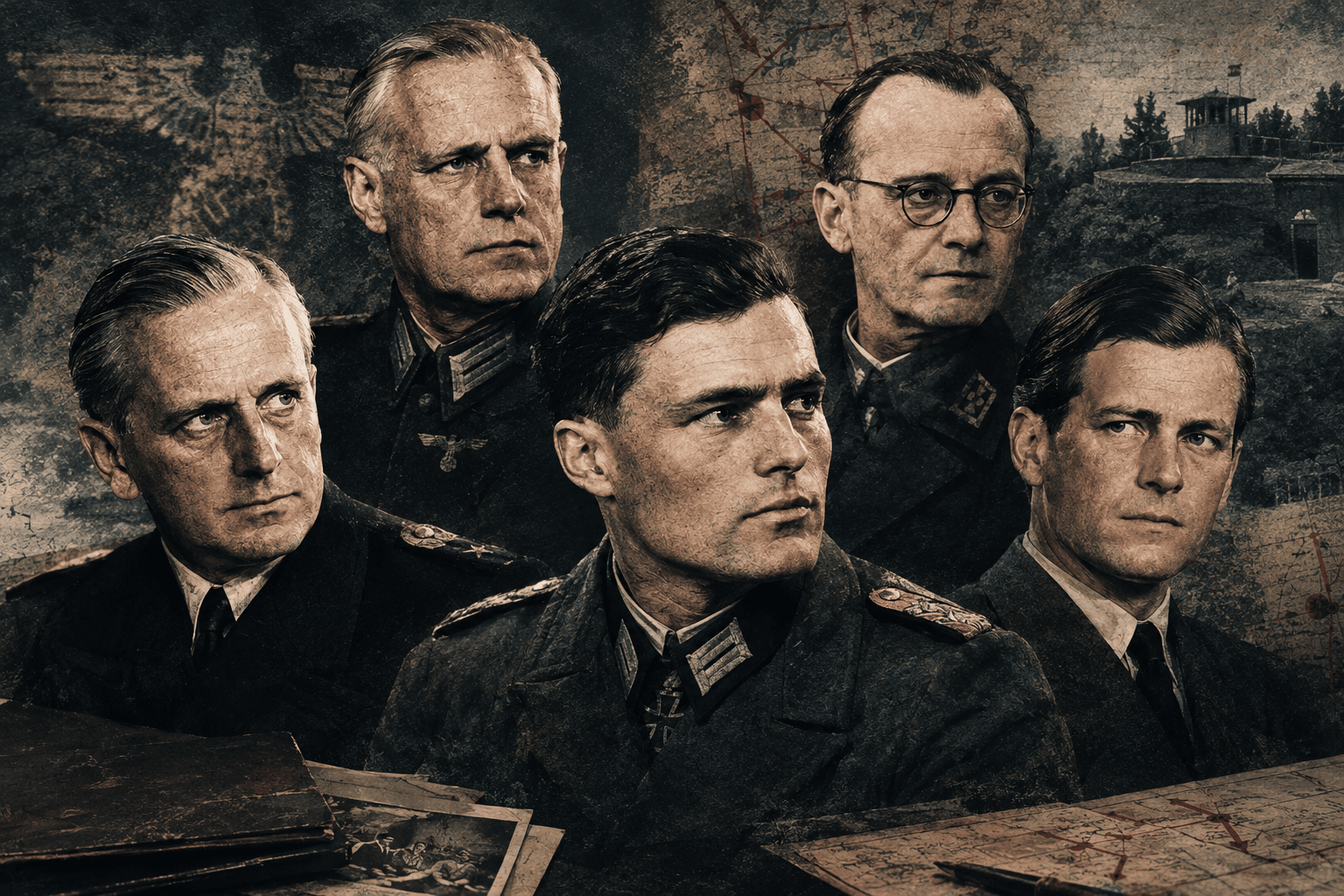
What makes someone a patriot rather than a traitor? In this interview, Juergen Bollmeyer discusses Traitor Patriots, the German resistance against Hitler, and the difficult choices faced by those who turned against their own regime.
About the Guest
Juergen Bollmeyer is a German-American writer, director, and historian whose work spans film, literature, and design. His book Traitor Patriots explores the military resistance against Hitler, drawing on meticulous historical research and narrative storytelling. A photographer and visual artist, Bollmeyer has also received multiple European television design awards. He lives and works between Germany and California.
Interview
Simon Sarevski: You wrote Traitor Patriots, a fascinating book about the resistance movement in Nazi Germany. What drew you to this particular part of the era, and what did you feel was missing from existing accounts?
Juergen Bollmeyer: My interest in history is well known among my friends and colleagues. A while ago, a friend invited me to look at a screenplay his father developed in the 1980s. It was an ambitious project about Abwehr chief Wilhelm Canaris. It presented a “heroic” version of the character that likely never existed. Wilhelm Canaris, an essential figure in the German resistance, was complex. He was many things, but not a hero.
I left the project, but I felt I had to tell a different story. I decided I had to tell the story of the men I considered the true drivers of the Wehrmacht resistance.
After the war, writers and historians eager to find “good” Germans often portrayed these men and women as noble characters, driven by an uncorrupted moral compass. They were anything but that.
I intended to show them as they were. Flawed humans with complex, diverse beliefs, strong convictions, and a code of honor. They all had to come to terms with the dilemma of serving an increasingly criminal, corrupt. and a ruthless regime.
With populism currently on the rise, it is impossible to ignore the relevance of the story of the men and women in the German military resistance. I believe the story offers a timeless, meaningful lesson. But it can only come from an honest account.
Quite fittingly, you call these men and women “traitor patriots.” Having spent so much time researching them, what does that contradiction mean to you? At what point does betraying one’s government become an act of patriotism?
Juergen Bollmeyer: The book has a moment when one of the resistance leaders, Hans Oster, tries to define exactly that. To him, it was deeply personal. It depends on a person’s convictions and value system, and on how you define “country.”
If you define it by its culture, then protecting and upholding its cultural values becomes a patriotic duty. If you define it by its moral values, its institutions, and its code of law, then protecting its institutions and upholding the rule of law becomes a patriotic duty. If you define it by group affiliation and subscribe to the idea of an ethno-nationalist state, then none of the above matters. Then it’s: “My country, good or bad.”
However, society is always eager to define it for you. But these standards are fickle. In post-WWII Germany, the young democratic Federal Republic considered men of the military resistance traitors. Their families were denied pensions and any support. Decades later, the same men were portrayed as noble heroes and considered true patriots. Who is, or, better say, who is considered a traitor and who is considered a patriot depends on society’s cultural shifts.
——— Related: Rainer Zitelmann on Nazi Economic Policy ———
The people we follow in the book came from very different backgrounds and did not necessarily want the same Germany after Hitler. What actually held the resistance together?
Juergen Bollmeyer: It was the realization that Hitler, the person initially admired and seen as a savior by many in the resistance, would doom Germany.
Stauffenberg joined the resistance only when Hitler began losing the war. Hjalmar Schacht, initially aiding Hitler in securing support of the business elites, switched sides early when he realized the Nazi economic agenda would bankrupt the country. Many in the military who had applauded Hitler’s rearmament program switched sides and joined the resistance when it became obvious that he wanted war. Some of the “old” Prussian officer class despised the upstart Hitler. Others like Goerdeler, Oster, and Gisevius hated Nazi ideology and the SS state. The Dohanyis and Bonhoeffer recognized Hitler’s corrupt and criminal nature right away.
Resistance members had vastly different visions for a post-Hitler Germany and were politically at odds. It was no brotherhood. But they all shared one belief. Hitler had to go.
Christopher Browning’s Ordinary Men famously shows how ordinary people can become participants in terrible crimes, challenging the comforting assumption that, had we lived in Nazi Germany, we would naturally have been among those who resisted. Traitor Patriots follows some of the relatively few people who actually crossed that line into active resistance. What made them different?
Juergen Bollmeyer: Browning argues that the backgrounds and biographies of men in Reserve Police Battalion 101 do not explain the cruelty and mass murder these men committed. They came from liberal Hamburg; they were too old to have been indoctrinated by Nazi “education,” and too young to be traumatized by WW1 trench warfare. Browning asserts that it was the group dynamic that transformed them into some of the most effective killers of the regime. To me, that sounds plausible.
So, what made the men of the resistance different? Hans Oster, Josef Müller, Bernd Gisevius, Goerdeler, von Dohnanyi, and Bonhoeffer did not define themselves by group affiliation. They joined the resistance for different reasons and with different agendas. For example, Stauffenberg’s vision of a post-Hitler Germany was fundamentally different from Goerdeler’s. But they shared one common goal. These struggles and internal conflicts within the resistance illustrate that these men were a collective of individuals rather than a uniform group.
One of the things I particularly liked about Traitor Patriots is that the men and women involved come across not simply as historical heroes, but as recognizably human. How mixed were their motives – patriotism, morality, religion, military honour, personal ambition, even self-preservation?
Juergen Bollmeyer: Yes, their motives differed vastly. Patriotism, morality, religion, military honor, personal ambition, and self-preservation all played a role. There was also vanity and frustration. Hitler’s incompetence as a military commander led many officers to join the resistance. These clashing ideas and motives ultimately doomed Operation Valkyrie.
Hans Oster’s energy and determination held the resistance coalition together. When the Gestapo revealed his activities, forced him out of office, and put him under house arrest, the resistance lost direction. Stauffenberg tried to fill the void. But he was no Hans Oster. Stauffenberg made grave errors. Goerdeler and Gisevius deeply mistrusted him. Many, including Ludwig Beck, shared their concerns. They questioned Stauffenberg’s judgment. They despised his ideology and political agenda. Many withheld their support when it mattered.
——— Related: Larry Reed on What It Takes to Be a Hero ———
Some of the people in your story served institutions that helped sustain Hitler’s regime before eventually resisting it. Was there usually a recognizable breaking point, or did opposition emerge gradually?
Juergen Bollmeyer: It was a gradual process. There were ardent anti-Nazis inside all German institutions from the beginning. That was true at all hierarchy levels. Some of the Berlin police leaders despised the SS and Gestapo. Hans von Dohnanyi in the Department of Justice enjoyed protection from some of his superiors.
But soon their hands were tied. One of Hitler’s early priorities was the dismantling of independent institutions. That included the judicial branch.
There was one exception. Hitler needed and wanted the Wehrmacht’s support. He made that decision early in 1934, when he turned against the Wehrmacht’s rival, the paramilitary SA, and had its leadership executed. The military eagerly protected its ancient privileges, and Hitler had to accept. That created a shield, a shelter. The Wehrmacht became the last small pocket governed by a rule of law, within an otherwise lawless Nazi state. The last German institution standing.
The bravery of the resistance outside the military, for example, the students of the White Rose, is impressive, yet they never posed a real threat to Hitler. The resistance within the military, on the other hand, could mobilize the resources to end Hitler’s regime. Bernd Gisevius realized this early and tried to find a way in. The men and women like him, eager to resist Hitler’s regime, came to the same conclusion. Over the years, many sought and found active employment within the armed forces. The Wehrmacht’s intelligence service, the Abwehr, was crucial. There, at least as long as Wilhelm Canaris and Hans Oster sat at the helm, could Hitler’s opposition organize and exercise effective resistance.
You mentioned to me that Josef Müller ultimately became the character around whom you rewrote the story. What was it about Müller that made you realize he was the person through whom this story needed to be told?
Juergen Bollmeyer: He was present in the most dramatic moments, from the early days of the resistance to the very last. Josef Müller was the Abwehr’s envoy to the Vatican and, by extension, to the Western Allies. He outsmarted the Gestapo several times. In his cell inside the Flossenbürg concentration camp, he caught particles drifting in the air that he believed to be the ashes of his fellow resistance fighters Hans Oster and Wilhelm Canaris, who had been executed and cremated the same day.
Müller was among the hostages shuttled by the SS from various concentration camps to the Nazi’s Alpine Fortress as a token for future negotiations with the Allied Forces. His life was spared when the Northern Italian SS and Wehrmacht, under Karl Wolff and General Vietinghoff, brokered a separate peace with the Western Allies on April 29, 1945, one week before the official German surrender. By Vietinghoff’s intervention, the execution commandos of the Bavarian SS were ordered to stand down and let the hostages go.
And last but not least, after the war, he invited Hans Oster’s son into his team to help rebuild and shape Germany’s institutions. Hans Oster would have liked that.
The resistance in your book isn’t a neat underground organization of only a handful of people. It’s a web of military officers, intelligence officials, civilians, clergy, and intermediaries. How did this network actually function, and how much did its members know about one another?
Juergen Bollmeyer: Two factors were decisive.
First: To secure the military’s support against the SA, Hitler accepted certain privileges and made concessions. Officers were guaranteed rights that civil servants outside the military had lost. For example, officers could be tried only by military courts. The Gestapo and SS had to be careful when confronting members of the military. That provided a shield for the members of the military resistance.
Second: The military intelligence service Abwehr. The Abwehr was the resistance’s center and engine. Abwehr deputy commander Hans Oster, the heart of the resistance, controlled the Abwehr’s checkbook and used its vast network and resources. He could invent missions as cover to send resistance members out disguised as spies. Oster used the Abwehr’s liaison officers to other branches of the military to recruit high-ranking officers into the resistance.
That said, all this was possible because Wilhelm Canaris, Oster’s direct superior and head of the Abwehr, knowingly tolerated Oster’s activities. Yet it seems to me Canaris was not fully committed. At times he withdrew his support. However, the Abwehr network and its financial resources made the effective resistance possible.
Hans Oster likely knew about almost all resistance activities and all active members within the officer corps. Support of senior officers was crucial. Only they had the authority to mobilize large combat units against the regime. When key commanders withdrew their support, activities stalled.
These people repeatedly had to decide how far they were willing to go — lying, leaking secrets, conspiring against their superiors, and eventually contemplating killing the head of state. Was there a line that was particularly difficult for them to cross?
Juergen Bollmeyer: Many officers drew a clear distinction between high treason and treason. High treason, freeing one’s country from a tyrant, could be reconciled with an officer’s code of honor. Treason, betraying one’s country, was taboo.
That was a clear line. That’s why Hans Oster is such an exception. He struggled deeply, yet he was willing to cross that line. He certainly had flaws, but his courage and determination are still inconceivable to me. When Oster’s revealed the Nazi operational plans and dates for the invasion of the West first to the Vatican, and then to the Dutch military attaché in Berlin, he calculated that his betrayal would cost the lives of up to 40,000 German soldiers. Yet he went through with it, knowing that his own son was part of the invasion force.
Several plots against Hitler came remarkably close to succeeding. Following these attempts through the people involved, what struck you most about why they repeatedly failed? I am inclined to think Hitler was extraordinarily lucky, but beyond that, was there something about the resistance itself that made failure more likely?
Juergen Bollmeyer: I fully agree. Hitler was extremely lucky. At the same time, it is important to remind ourselves that Hitler’s assassination was only part of a greater effort: A full coup attempt. The conspirators wanted to avoid a German civil war by all means. Therefore, killing Hitler was not enough. They had to break the SS state and prevent a counter coup. That required a widespread network and increased the risk of leaks and betrayal.
However, the resistance had, more than once, a full cabinet of highly qualified economists, politicians, and officers in place, ready to govern post-Hitler Germany from day one. More than once, elite military commandoes were in place to storm the Reich Chancellery and SS headquarters. In 1938, Reinhard Heydrich sat armed in the cafeteria of the SS headquarters, expecting Wehrmacht commandos to storm the building and have him executed.
Many coup attempts failed for the same reason. Some senior officers faltered and withdrew support at the last minute. Corruption within the officer’s corps was a main factor. Hitler installed a system that offered direct bribes and generous financial benefits to keep the generals in line. And he succeeded.
Wilhelm Canaris was perhaps the character I found most difficult to pin down. At times he appears deeply involved in the resistance, while at other times he seems to step back, hesitate, or even move in the opposite direction. How did you come to understand him? Was he ultimately a committed resister, a cautious survivor, or something more complicated?
Juergen Bollmeyer: Canaris remains an enigma. And that is by his own design.
At first, it seems he truly admired Hitler. He considered the SS / Gestapo state as the enemy committing atrocities without Hitler’s knowledge. He seems to have held that belief as late as the Blomberg-Fritsch Affair in 1938. He only opened his eyes in 1939, when Keitel made it blatantly clear that the atrocities in Poland were commanded by Hitler directly.
Canaris’ relations and friendship with Reinhard Heydrich are stunning. Canaris is appalled by the SS and Gestapo conduct. Still, on Sundays he spends time with the man behind it, Reinhard Heydrich, who is also his neighbor and plays the violin in the private home concerts hosted by Canaris’ wife Erika. Canaris is aware he has become Heydrich’s target, but when Heydrich is assassinated, he cries.
Canaris tolerates Hans Oster’s activities and provides cover and sometimes support, but always keeps an escape path open.
Canaris liked the spy games, the charades, and was brilliant at it. He wanted to be an enigma. He loved when people marveled at him and his true convictions. He kept playing his games even when facing execution in the Flossenbürg Concentration Camp. Only when confronted by Oster, who freely and proudly admitted his opposition to Hitler and the regime, did Canaris let the curtain drop. He finally takes sides and admits that he was part of the resistance.
Whistleblowing is a modern form of resistance often seen as courageous, even heroic, though controversial to say the least. Could someone like Oster or Gisevius have exposed what Hitler was doing or planning in a way that meaningfully changed events, or is that a very modern way of thinking that misunderstands how information and power worked inside Nazi Germany?
Juergen Bollmeyer: Whistleblowing makes sense in a social, political, and judicial environment that listens and can hold the culprit accountable. Once the rule of law is gone, whistleblowing is meaningless.
For men like Oster and Gisevius that environment did not exist. After the Enabling Act of 1933, the German Institutions were purged and aligned with Nazi ideology.
There was one exception, though. In the early days after Hitler’s power grab, whistleblowers could still turn to one person. One person could have stopped Hitler: President Hindenburg. He had the authority to dismiss Hitler. The Wehrmacht command actually tried and succeeded. In 1934, Hindenburg ordered Hitler to drive 250 miles to his country estate, dressed him down, and sent him back to Berlin. Hitler’s days seemed numbered. A couple of weeks later, Hindenburg died. After Hindenburg’s death, Hitler instantly abolished the German Presidency as an institution and replaced it with the “Führer.”
Later, whistleblowing, to a degree, played a part when Canaris toured the Wehrmacht headquarters to reveal Hitler’s plans to the shocked officers. But otherwise, whistleblowing was meaningless. Violence, assassination, and a coup were the only remaining options.
Norman Ohler’s Blitzed puts considerable emphasis on the role drugs played in Nazi Germany. In Traitor Patriots, unless I missed some instances, drugs come up only three times. Was that simply because drugs weren’t particularly relevant to the story you were telling, or did your research leave you less convinced than Ohler about the wider role they played?
Juergen Bollmeyer: Ohler is certainly correct. However, when writing Traitor Patriots, I established one rule. I wanted to tell the story through the eyes of the resistance members. I wanted a certain point of view. I wanted to present facts and show their impact through the eyes of the key protagonists.
Helmut Groscurth was one of the resistance’s key figures. His agonizing experience on the Eastern Front, his attempt to save children from executions, seemed the right story to illustrate the madness. I could not think of a more drastic illustration of the regime’s ruthlessness and the cynical use of drugs being administered to the German fighting force as given in an eyewitness report I found describing an execution squad high on Pervitin, massacring the children Groscurth tried to save.
Then there was Theodor Morell, Hitler’s personal doctor, famous for the drug cocktails he provided. Hitler’s and Göring’s excessive drug consumption was infamous, clouding judgment and shaping their personalities. Canaris and everyone reporting to Hitler regularly could not overlook the abuse.
Having spent so much time with Oster, Müller, Gisevius, Canaris and the others, did writing Traitor Patriots change your own understanding of what courage, loyalty or patriotism actually means?
Juergen Bollmeyer: Courage, loyalty, and patriotism are considered virtues. But these virtues aren’t automatically forces for good. It depends.
Loyalty to a certain ideology, culture, nation, or party can become a dilemma when its values shift or erode. I connected to Hans Oster and could relate to his struggle. Hans Oster considered himself a patriot. And as such, he supported the rearmament program. When he realized where this would lead, he reassessed. Oster had pledged loyalty to a political movement and country, but he reconsidered when he realized the nation’s values no longer aligned with his values and moral compass. I respect him for it.
In contrast, Bonhoeffer’s and Dohnanyi’s loyalty belonged above all to human rights and dignity. They did not need to reconsider.
What’s next for you after Traitor Patriots? And I have to ask – can we expect a Netflix series at some point, because this story certainly deserves one.
Juergen Bollmeyer: I’m working on two book projects. My current favorite recounts the second Greco-Persian War from an unexpected perspective.
It’s the story of the power struggle at the Achaemenid court before Xerxes committed to the campaign. It is a timeless case study showing the unpredictable risks superpowers, in this case the Achaemenid Empire, face when confronting an enemy they don’t understand. The story that emerges from all historical accounts differs dramatically from the heroic version we know from movies or popular literature. Compared to the historical records, these versions are rather bland.
As for Traitor Patriots on Netflix, Apple, or Amazon Prime, we’ll see. I can picture a docu-drama approach. But I’d like to add another story layer and broader context. It would be interesting to interview military leaders, have them reflect on the story, and draw parallels to decisions they had to make.
After finishing Traitor Patriots, which books would you put next on the reading list for readers of this interview?
Juergen Bollmeyer: I had to take a break from the currently trending gloom-and-doom media narrative. So I read Tony Seba’s Stellar. No matter what, I remain an optimist. And it seems Tony Seba does, too.
When I first started doing interviews, I was inspired by Harry Browne when asking this question, but after Traitor Patriots, it feels particularly fitting to ask you: How do you find freedom in an unfree world?
Juergen Bollmeyer: I believe you can’t. Our world, our ecosystems, our economies are connected. We face global challenges that require global solutions. Freedom, safety, and independence in an unfree world are an illusion. If your freedom or privilege is built at somebody else’s expense, someone will challenge it.
What remains, maybe, is total retreat: making yourself invisible, vanishing into a remote corner of our planet, so secluded and irrelevant that you are left alone. But then I would not call that existence freedom. Freedom and the pursuit of happiness need a framework, a guarantee.
When Hammurabi voluntarily had the first code of law chiseled into stone, our journey toward freedom began. Freedom can be achieved only when legislators recognize, grant, and guarantee it as a human right through a binding contract like a constitution.
It needs the rule of law and strong, independent institutions to protect it from corruption and despotism. Oster, Goerdeler, Givsevius, Dohnanyi, and Bonhoeffer sought to reestablish such a system. That’s what they fought for. That’s what they died for.