
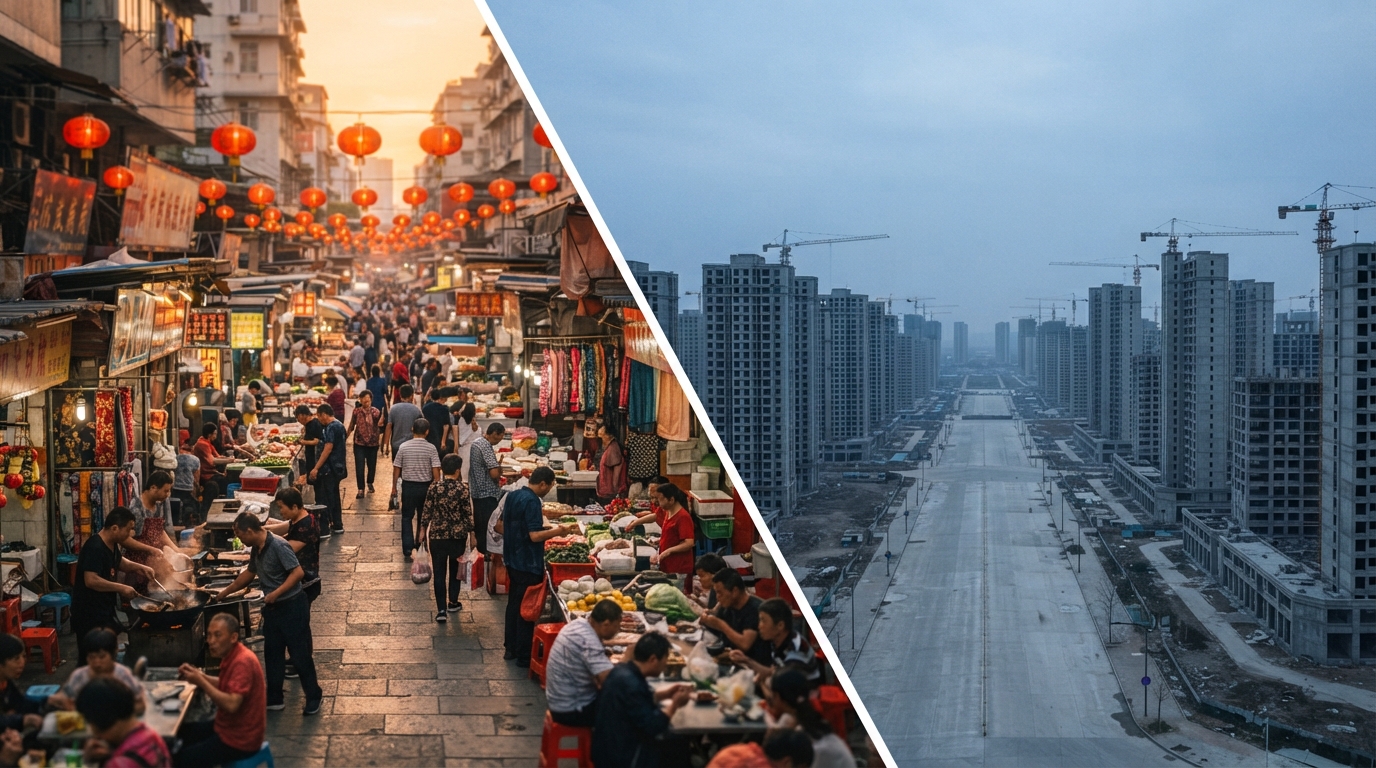
Is China a market economy, or only one in appearance? Weiying Zhang joins us to discuss why China’s market reform is still unfinished, why central planning cannot correct its own errors, the limits of official growth figures, and how China got rich by releasing people, not by directing them.
About the Guest
Weiying Zhang is a Senior Professor of Economics at the National School of Development at Peking University and Director of the Tsientang Institute for Entrepreneurship and Innovation. He is the author of The Logic of the Market and Re-Understanding Entrepreneurship, both Hayek Prize finalists.
Interview
Simon Sarevski: China runs on private businesses, yet the Communist Party controls the country. Where does the market end and the state begin in this “capitalism under a socialist system?”
Weiying Zhang: China’s institutional transition from a planned economy to a market economy is unfinished. Four decades of reform have changed the ownership structure and the price system, but they have not changed who holds ultimate authority over economic decisions. The government still holds considerable power over how the market operates, and that power is not marginal; it is decisive.
Therefore, in China there is no clear boundary between the market and the state. The boundary can be stated simply in theory: the state makes rules and implements them, and it does not intervene at its own discretion in the affairs of private business. The state is the rule-maker, not the decision-maker. In reality, the state remains the biggest owner of business, and even private firms are heavily controlled by government regulations, through approvals, licences and inspections that decide whether a company may operate, expand, or exit.
My view goes deeper than the question assumes. The market system is fundamentally inconsistent with socialist principles. A market economy rests on private property, free contract, free entry and dispersed decision-making; socialist principles assign to the state the ownership and the direction of the economy. You cannot put one inside the other and call what remains a boundary. What you get is what China has: a market in appearance, and administrative control in substance.
Hence the conclusion follows without qualification: only when the state withdraws from the economic sector can there be a clear boundary between the market and the state. Withdrawal is not one policy among others; it is the precondition. As long as the state is both owner and discretionary regulator, every boundary will be redrawn by the state itself, and a boundary drawn by one of the parties is no boundary at all.
I find that even the Western countries are increasingly becoming ambiguous between the market and the state. This is dangerous!
Entrepreneurship requires secure property rights, predictable rules, and independence from political power. I find it difficult to wrap my head around how entrepreneurship works in China, especially since Xi took power and cracked down on tech giants and billionaires. Why would anyone take a big risk there now? Could you enlighten me?
Weiying Zhang: To answer this question, one needs a nuanced understanding of entrepreneurship. Entrepreneurs are individuals who: 1) are driven by forward-looking expectations; 2) possess a strong, often overoptimistic, confidence; 3) demonstrate remarkable resilience in the face of setbacks; and 4) uphold a strong sense of responsibility.
China’s entrepreneurial class has emerged gradually alongside the reform and opening-up process launched in 1978. As markets opened incrementally, entrepreneurs’ expectations and confidence about the future took shape step by step. Such beliefs, built over decades, cannot be erased overnight.
Reform remains an official policy, and no one openly denies reform. This creates some kind of illusion. In fact, while the government holds substantial regulatory authority, room for private business activity still exists; not all avenues are closed.
Furthermore, once entrepreneurs launch a business, they cannot easily discontinue operations at will. They bear obligations to their clients and to the workers they employ.
Many Chinese entrepreneurs have learned to navigate the institutional environment and engage constructively with regulators. Some of their bets may turn out wrong, yet embracing such risk is inherent to entrepreneurship.
So long as the private sector is not fully prohibited, entrepreneurial individuals will not abandon hope. Many continue to hold out the prospect of a new round of market-oriented reforms in the spirit of Deng Xiaoping’s reform and opening-up initiative.
China has reported extraordinary economic growth for more than four decades. The Soviet Union reported impressive numbers that were far rosier than reality. Why should we believe China’s?
Weiying Zhang: Setting aside official GDP statistics, there is little doubt that the living standards of ordinary Chinese people have improved substantially. One illustrative benchmark is the time an urban worker needed to earn enough to buy one kilogram of eggs: on average, this required 407 minutes of work in 1978, but only 15 minutes by 2019, down by 96.3%! This is really extraordinary!
Similar patterns emerge when we examine many other consumer goods, pointing to a clear rise in purchasing power.
—— Related: Johan Norberg on progress and globalization ——
That said, it is well documented that local officials sometimes manipulate statistical figures to suit their incentives. Depending on bureaucratic pressures and career concerns, they may overstate or underreport economic outcomes. Some of these pressures originate from growth targets set by the central government; over-reporting of headline growth has become a common concern in recent years.
As a result, officially published growth rates often diverge from the lived economic experience of the general public. Personally, I remain skeptical of the most recent official growth figures.
A key distinction from the Soviet case is that China’s market reforms created a large, decentralized private sector and observable consumption gains that are harder to fabricate wholesale, even if aggregated national accounts contain upward biases. The Soviet Union’s inflated statistics, by contrast, coexisted with chronic shortages and stagnant household consumption for decades.
This tangible improvement in material life is the main reason many economists treat China’s growth record as fundamentally real, even if its precise magnitude is debated.
The problem with central planning is not necessarily underproduction, but the overproduction of things people don’t want to buy. China offers some striking examples: underused high-speed rail lines, ghost cities, zombie companies and empty industrial parks. Am I being too critical here, or is this simply the kind of government-planning inefficiency we see in the West as well?
Weiying Zhang: You are not too critical. You are using the wrong word. This is not inefficiency; it is the predictable output of a system with no mechanism for correcting error.
Planning fails by producing, confidently and at great expense, what nobody wants to buy — not because planners are stupid, but because the knowledge does not exist in a form a ministry can aggregate. It exists as prices, the compressed judgements of millions of buyers, and as the losses of firms that guessed wrong. Prices tell you what to stop doing; that is their most valuable service. A plan abolishes the signal and the sanction, then wonders why it cannot see.
A firm that builds the wrong thing fails quietly, and its assets pass to someone with a better idea. A province that builds a city nobody lives in does not fail, because nobody is bankrupted by it: officials are promoted, banks roll the loan over, neighbours copy, and the loss passes to savers and to the future. The market economises on error; the plan accumulates it.
The West has government failure too, but three things differ. There the state is the fixer of last resort, not the investor of first resort. Boondoggles die when governments change. And the waste is argued over in public, while here it is amortised in silence.
We can see what China builds. What about what it doesn’t build outside the big cities? Has China prioritised what looks impressive over what actually helps people?
Weiying Zhang: Yes. And not because planners are vain, but because the budget follows the official’s career, not the citizen’s life.
What can be photographed gets built: stadiums, skylines, bridges a delegation will drive across. A sewer is never photographed, a rural clinic is no photo opportunity, and a school in a county losing its young sits on nobody’s inspection route. Money follows visibility, visibility follows power, and power does not follow need.
Nor is this mere vanity. Local governments live off land, and land prices rise when you build the kind of city that looks prosperous. That is a rational response to a perverse rule — which is why moralising achieves nothing and changing the rule changes the skyline.
Then there is household registration, the largest institutional arbitrage in the world. Cities take the labour of two hundred million migrants without paying for their schools, clinics, housing or pensions: value is captured where the work is, cost left where the family is. That is why safe water, sewage, clinics and care for the old are exactly what a village cannot buy and a city has no incentive to provide.
Where the user cannot choose and cannot complain, the provider answers to whoever pays him. The remedy is not better intentions. It is a mechanism through which being wrong costs something.
Depending on how you run your calculations, China’s public debt looks considerably different, often far lower than the real picture. Is it a ticking time bomb, or are the doomsayers overreacting?
Weiying Zhang: Neither a bomb nor a storm in a teacup. It is a slow tax on savers, which is why it is so hard to see.
The first question is not how much debt there is, but where the balance sheet ends. Official debt looks modest. Add local financing vehicles, the policy-bank lending behind them, the implicit guarantees that make companies look sovereign, and state enterprises that will never be allowed to fail. Debt is only as large as the entity that must repay it, and when that entity can be changed by an accounting decision, the ratio measures discretion, not obligation.
Someone always pays, and there are only three channels: growth, inflation with financial repression, or default. In an economy of soft budget constraints, I can tell you which is chosen before it is chosen — the least visible one. Repressed deposit rates, banks holding the paper, households never told they have lent: the bondholder is not the party at risk; the saver is.
Doomsayers are usually right about the arithmetic and wrong about the clock, because a sovereign with a closed capital account can roll debt for decades. Expect no explosion, only a long transfer: low growth, high savings, a generation paying for infrastructure it will not use. Debt, in the end, is a symptom. The disease is investment without an owner.
— Related: John Cochrane on debt, inflation and the next crisis —
China’s social credit system sounds like something taken straight from a dystopian novel. How’s life under a system that “scores” your every decision?
Weiying Zhang: Two different systems are being confused, and the confusion is the whole problem: credit information, which markets need, and an administrative score, which replaces law with discretion.
The first is who pays his bills, who honours a contract, who has been to court and lost. Every market produces it and is healthier for it; it is the immune system of exchange among strangers. The second is a score issued by the state, fixed to persons and firms, used to allocate credit, travel, tenders and school places, and adjustable at official discretion. That is not information. That is discretion with a number attached.
Law means the rule is known beforehand, applies equally, and is judged by someone who does not gain. A score means the rule is known afterwards, applies differently, and is judged by the beneficiary. Call one governance and the other government, but do not call both law.
The economic damage is worse than the moral one. Trust among strangers is grown by repeated dealing under rules that hold; a score issued by the referee produces only obedience, and obedience is expensive: it needs surveillance, it invites corruption, and it allocates credit by loyalty rather than productivity. A bank lending to the better score rather than the better balance sheet is doing politics with depositors’ money.
— Related: Michael Munger on trust and trading with strangers —
And to score everyone you must centralise the very knowledge by which markets discipline one another. People who know they are scored learn to live as they expect to be seen. A society that cannot be unpopular stops inventing.
The one-child policy left a shrinking, ageing population and far more men than women. Could this be China’s undoing?
Weiying Zhang: It will not undo China, but it is the cleanest proof in modern history that planning fails. The proof is arithmetic, and it arrives twenty-five years late. Family planning was a policy with disastrous results.
Apart from human rights issues, there are three errors. Knowledge: the optimal population depends on technologies not yet invented, on what parents want, on the shape of cities in fifty years. No committee can know it.
Incentive: a quota on births is a quota on women’s bodies, and the cost falls on those with the least voice. Rural households hid births, underreported daughters, preferred sons; the sex ratio you now deplore was the predictable product of a quota plus a preference, and it was visible in the arithmetic before the policy was announced.
Time: benefits were to arrive at once, costs after a generation. Demography is the longest feedback loop in government. Those who decide are gone before the bill arrives, and those who pay were not yet born.
Demography is a constraint, not a destiny; Japan and Korea aged and stayed rich. What ageing removes is the easy source of growth — and here is the irony. The demographic dividend was never planned. It was a byproduct of reform, two hundred million people moving to where the work was, a movement no ministry organised.
The planners now claim credit for a dividend their own policy was working against. Family planning and economic planning are one idea in two costumes: that a central authority knows better than millions of families what those families should want. If you want to teach why planning fails, do not give a student a steel mill. Give him a birth quota.
Are we sliding into a new Cold War between China and the West, and what would it cost the rest of us?
Weiying Zhang: It is not a cold war. It is a competition of systems, which is both more dangerous and more winnable than a war of blocs.
Blocs have frontiers and end when a wall falls; systems end when an argument is lost. What we have is one order in which the state directs capital toward national goals against one in which capital is dispersed and disciplined by consumers, laid over a real technological and military rivalry.
The costs are concrete. The division of labour is the cheapest productivity machine ever invented, and it is being dismantled for reasons that are half security, half theatre. Smaller countries will be asked to choose and will lose either way. Consumers pay a tax they never voted for; mutually beneficial trade and cooperation slow down; military budgets grow even in countries with no stake in the quarrel.
——— Related: Robert Tyler on Europe’s strategic crossroads ———
The deeper cost is the conversion of economic questions into security questions. National security is a self-fulfilling prophecy. Once an issue is security, you will create your own enemies. Reasoning is suspended and any interested party can dress in uniform; a security framing is unanswerable, which is exactly why it attracts those who cannot win on merit.
The danger is not that the two countries fight. It is that both learn to govern by emergency, and find they like it.
And a warning to my Western friends: the last Cold War was won because one system delivered more of what its people wanted. Build a system that protects incumbents, subsidises failure and calls every inefficiency strategic, and you will lose an argument you think you are winning.
I’ve been hard on China throughout this interview, but its transformation is undeniable. What can the rest of the world learn from it?
Weiying Zhang: The lesson is the opposite of the one usually drawn. China got rich by releasing people, not by directing them.
Count what happened. Communes dismantled. Farmers kept what they grew above the quota. Townships allowed to run factories. Private firms legalised. The coast opened. Two hundred million people allowed to move to where the work was. Every step transferred decision rights from officials to ordinary people, and not one required the state to know the future. The state’s contribution was restraint — which is a policy, but a modest one.
The method mattered as much as the direction. Reform was experimental, incremental, allowed to fail locally: a policy tried in one county, copied where it worked, dropped where it did not, with errors small enough to survive. That is how markets work — a discovery procedure, not an implementation. A reform that cannot fail cannot learn.
And then the warning. The order that permitted the release kept the power to retake it, and success bred the belief that success had been engineered. The greatest danger of a successful state-directed economy is not that it will be copied. It is that it will learn the wrong lesson from its own achievement, and stop reforming exactly when it most needs to.
To end on a Strixly note, how doyou find freedom in an unfree world?
Weiying Zhang: Simply speaking, hold a free mind. This is the most important thing for scholars and intellectuals.
Freedom is not a condition you are given. It is a practice you keep.
Two freedoms should not be confused. The first is the freedom to do what no one forbids — to move, to contract, to speak, to publish. It is institutional: it needs law that binds the governor, property that cannot be taken at will, courts that can say no. Without them you have permission, and a permission is never freedom.
The second is the freedom no one can take: to think, to judge, to refuse. It is not granted and cannot be confiscated, and it is the more important of the two, because it is the ground from which institutions are rebuilt.
So do not confuse freedom with exemption. The man who asks power for a favour has traded freedom for privilege, and he will be sent the bill. Keep your distance from power: the closer you stand, the less you can say, and the more you must believe it.
Build something that exists without permission — a business serving customers, a school that teaches, a book that outlives its author. Tell the truth in the smallest circle you can find, then widen it by one person at a time.
A free person accepts the consequences of his own judgment, which is exactly what the market asks of the entrepreneur and what the planner refuses to ask of himself. An unfree world can take your office, your money, your name. It cannot take the habit of thinking for yourself — unless you hand it over.