
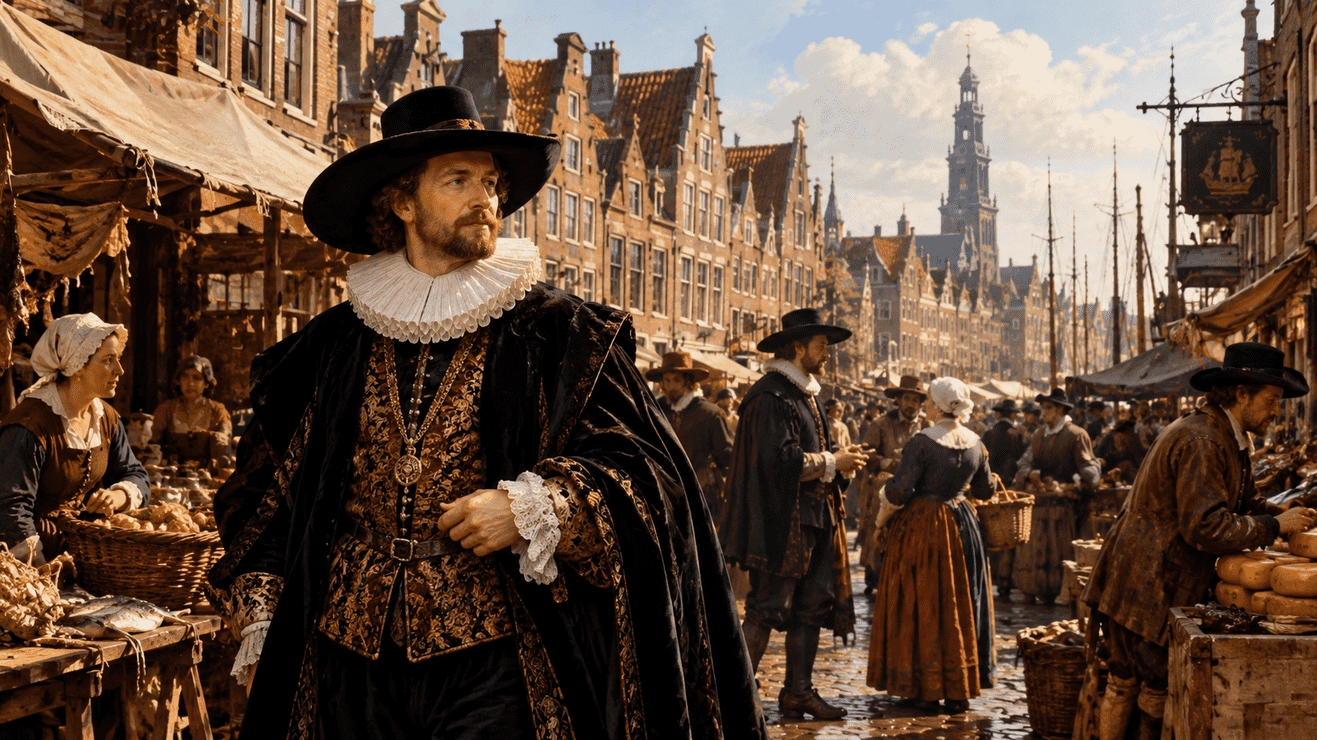
In this interview, Deirdre McCloskey discusses how bourgeois culture helped produce the Great Enrichment and why capitalism deserves more credit for rising living standards. She argues that human progress depends on liberty, innovation, and bourgeois virtues, defending the social changes associated with greater individual autonomy.
About the Guest
Deirdre McCloskey is a Distinguished Scholar and holds the Isaiah Berlin Chair in Liberal Thought at the Cato Institute. She is also a Distinguished Professor Emerita of Economics and History, and Professor Emerita of English and Communication, at the University of Illinois Chicago. Her best-known works include the Bourgeois Era trilogy — The Bourgeois Virtues, Bourgeois Dignity, and Bourgeois Equality — as well as Why Liberalism Works and If You’re So Smart.
Interview
Simon Sarevski: What is the bourgeoisie, what are bourgeois values, and why should we care?
Deirdre McCloskey: It is the normal adjective in French and in academic English and in Marxist discourse for the middle-class rulers of cities — the manufacturers, storekeepers, lawyers, doctors, accountants, and their upper managerial employees. In French, it is also the singular masculine noun for such a person, if male, as they usually are. [Bourgeoise (note the ending) is the feminine, used in English only as a little, silly, proud joke showing that the writer actually knows French.] Bourgeoisie is the normal English and French and Marxist name of the entire class of such people.
Simply the usual virtues such as prudence and courage and love when expressed in a bourgeois life, as my book The Bourgeois Virtues which shows they are. (Not “values,” which term would not acknowledge the long history in all societies of talk about the good and admirable life, such as “pagan virtues” or “Confucian virtues.”)
As for why we should care, it is because we are writing academic English, or talking to Marxists. More deeply, we need a name for such people. Even more deeply, such people have been crucial in making the modern world — such as starting the American and French revolutions, and gradually advocating the equality of permission anciently typical within such a class, which subsequently let poor people such as Benjamin Franklin, Abraham Lincoln, or Adolphe Thiers rise into such a class by innovation or luck or wit.
A major theme in your work is that the Great Enrichment was not primarily caused by capital accumulation or institutions alone, but by a change in rhetoric: society began respecting merchants, innovators, entrepreneurs and ordinary people. In a sense, the creation of a bourgeois culture. Why did that shift happen when it did, and why did it take hold in the Netherlands and England?
Deirdre McCloskey: The Great Enrichment was not caused by capital accumulation or institutions alone—or not much at all, these being merely weakly necessary causes, not sufficient. So drop the “alone.”
That’s right. Ideas, ideology, and ethics changed, especially the fall of aristocratic versions of the virtues.
And more precisely in the province of Holland, Scotland, and the Northern American colonies of Britain. I give the evidence in the big (700 pages!) third volume of the trilogy, called Bourgeois Equality. Briefly, for no deep reason of European superiority ideas changed. It could have happened eventually elsewhere, but northwestern Europe got there first, by a series of happy contingencies, such as the English victory over the Spanish Armada in 1588.
You often argue that innovation, not merely redistribution, is what dramatically improved living standards. Why do so many modern political debates still focus almost entirely on dividing wealth rather than creating it?
Deirdre McCloskey: Because their participants do not look at the evidence or purposely distort it, do not have quantitative minds or training, are not good economists, or hate “capitalism” without understanding it, and so forth. Here’s the fact: “capitalism” enriched poor people by a minimum of 2,500 percent, the Great Enrichment. By contrast, redistribution from rich people to poor people can raise the incomes of poor people merely 50 percent. So it’s 2,500 vs. 50. You see what I mean by saying that someone who focuses on inequality does not have much of a quantitative sense. I regard it as an intellectual and ethical failure, such as by Piketty and Mazzucato.
——Related: Art Carden on the Origins of Modern Prosperity——
Are we once again entering an era in which commercial success and entrepreneurship are viewed with suspicion? We admire the innovations associated with Steve Jobs, Jeff Bezos, and Elon Musk, yet often resent the wealth and influence that followed. Is that a contradiction, or a valid distinction?
Deirdre McCloskey: It has always been so, especially in Christianity since Jesus of Nazareth, St. Luke, St. Paul, and the early Church Fathers. No other religion is so suspicious of rich people. Jews, Moslems, Zoroastrians, Hindus, and Buddhists, or, for that matter, most pagans, feature use like the rhetorical venom directed at business.
Yes, it’s a contradiction, a childish one. What we need is liberalism, and a less envious and childish version of Christianity. Call it adultism.
Critics of capitalism argue that bourgeois society produces innovation and wealth, but also inequality, consumerism, environmental degradation and social fragmentation. What do they get right — and what do they fundamentally misunderstand?
Deirdre McCloskey: They get the innovation right, though then they downplay it. Inequality is, by actual comparative Gini statistics (collected by Sam Bowles, for example), the same in all societies. Yes, the crony capitalism such as Trumpism that I hate, just as much as my friends on the left, results in more inequality. Occupational licensure, for example. Patents. Public-private “partnerships” (that is, monopolies). Government contracting corrupted. The solution is to get rid of state-sponsored monopolies and corruption, not to make more of them with more regulation.
The modern developed world is drifting away from bourgeois virtues, isn’t it? What is driving that change, and what costs might we eventually pay for it?
Deirdre McCloskey: Yes and yes. What is driving it is a childish belief by the public in magical abundance through more laws (minimum wages, tariffs) and equally magical thinking among politicians and intellectual leaders, such as journalists and professors — “modern monetary theory” is a recent example.
Are these failures of bourgeois society, signs that we’ve abandoned bourgeois virtues, or something else entirely?
Deirdre McCloskey: Certainly not.
What, if anything, could reverse them?
Deirdre McCloskey: Nothing, the only “we” being the state, which usually has caused with its interventions the very “problems” that excite the blogs and TV shows. H. L. Mencken had it exactly right a century ago: “The whole aim of practical politics is to keep the populace alarmed (and hence clamorous to be led to safety) by an endless series of hobgoblins, most of them imaginary.” Since he wrote it’s gotten worse worldwide. Now when it rains, people slavishly complain to their masters of the government to do something about it. It’s what Hayek meant in worrying about The Road to Serfdom. Or to a version of childhood for grownups.
Is the bourgeois ethical worldview at odds with the teachings of major religions today? Or are bourgeois virtues in some sense compatible with — or even rooted in — older religious traditions? I ask partly because we seem to be experiencing both declining religiosity and declining bourgeois virtues at the same time, which appears counterintuitive if the two are truly opposed.
Deirdre McCloskey: I’ve written a long book, as yet unpublished, answering the questions, The Christian Liberal.
You do not know the facts. Religiosity is expanding worldwide. It’s not in a form, admittedly, that I myself admire and practice, namely Anglicanism or other mainline Christian religions, such as American (Northern) Baptism. But evangelical enthusiasm in Africa, for example, is a wildfire, and has led literally millions of men to stop drinking and whoring and beating their wives, and to start taking care of their families.
Culture — bourgeois culture, one might say — seems essential for sustained prosperity and human flourishing. But how does a society actually develop such a culture?
Deirdre McCloskey: Read Bourgeois Equality to find out the history. And read The Equality of Permission. Or just send me money.
Briefly, by private persuasion. By examining the historical and economic evidence. You seem to want to know some “policy” the state can apply. Please, grow up: there’s no magic wand, just adultism and sober inquiry and honest discourse.
Why have so many developing countries struggled to replicate the Great Enrichment, despite access to modern technology, economic knowledge, and a long historical record of what has and hasn’t worked?
Deirdre McCloskey: Because, in the innocent if ignorant case, they seek shortcuts through the state instead of letting their people have a go. And then there’s the non-innocent case.
—— Related: Johan Norberg on Progress and Globalization——
If dignity and the freedom to innovate helped drive the Great Enrichment, what happens when AI can do more of the work people once took pride in? Will it give more people the means to create, or could it weaken the agency and sense of purpose that sustain a bourgeois society?
Deirdre McCloskey: It will give more income to us all. It’s just a Turing machine, an input-output accumulator of conventional knowledge, a library in a box. Samuel Johnson said about such hobgoblins exercising people, “Clear your mind of cant.” Good advice. Read the best novels, good history, sensible economics, non-hysterical technologists, and grow up.
And to close, the question I ask every Strixly guest: How do you find freedom in an unfree world?
Deirdre McCloskey: Stop using the word “freedom,” which in English has been corrupted to mean “having stuff.” Use “liberty,” which on English tongues still means “not having an involuntary master.” Such liberty leads to such “freedom.” Advocate, therefore, for liberty — equality of permission, the primary liberalism of 1776–1789, adultism. Let my people go.