
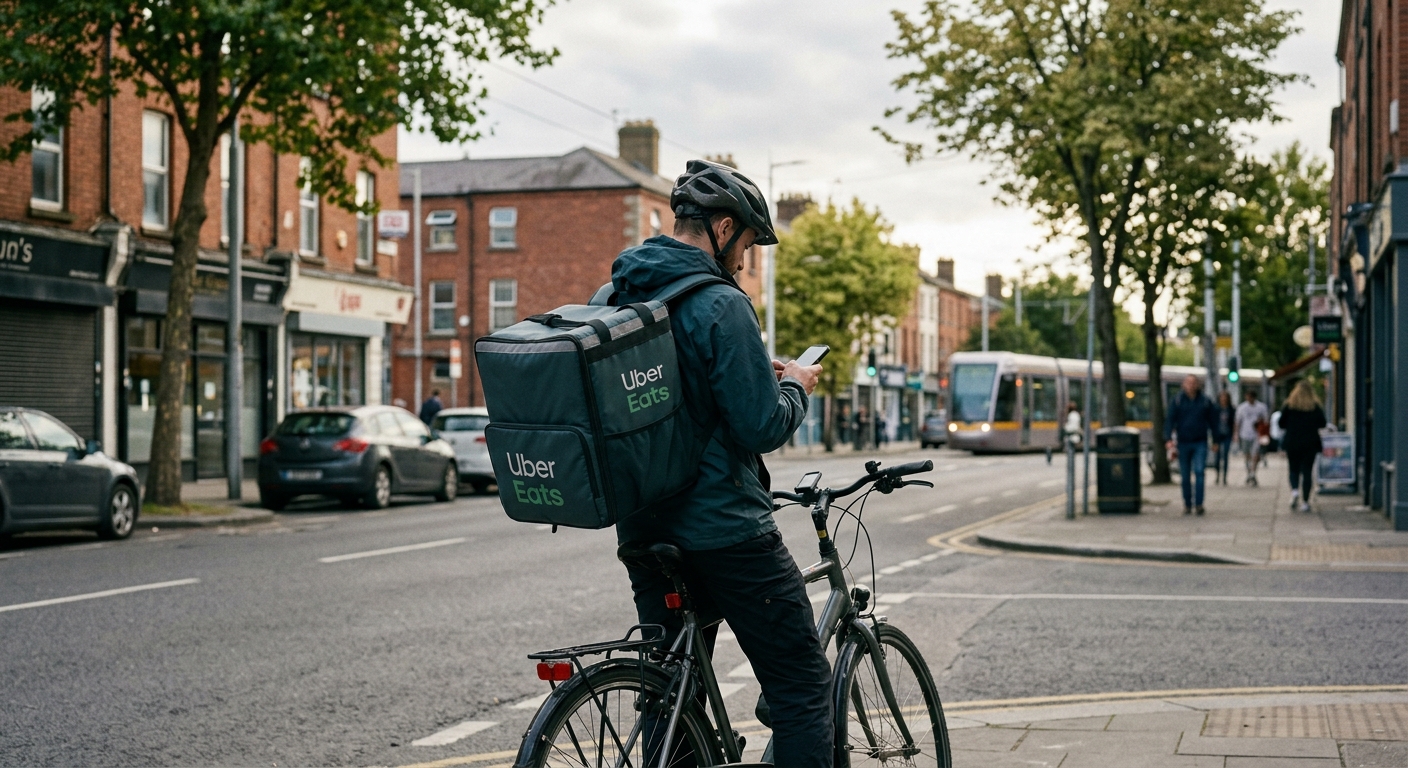
Flexible work and fair pay are central to the debate over how technology is changing employment. Paul Jackson examines how technology can help ensure workers are paid for their work, why the balance between efficiency and autonomy matters, and whether we can make work fairer without sacrificing freedom.
About the Guest
Paul Jackson is the founder of Salaree, a UK technology company focused on advancing the UN Sustainable Development Goal of Fair and Decent Work for All. His work focuses on tackling unpaid labour, wage theft, and migrant visa exploitation in adult social care, the gig economy, and the wider flexible workforce.
Interview
Simon Sarevski: Since definitions matter, when you talk about work that goes unrecorded or unpaid, what do you mean exactly, and which parts of the economy are we talking about?
Paul Jackson: The short answer is that all the flexible-work sectors I’ve spoken to have issues with accurately recording work, as well as assessing other statutory benefits to which workers in these sectors are entitled.
The reason is technological evolution. The original method was physical timesheets on paper, which people on any kind of contract or flexible-work agreement would fill in to record when they started and finished.
Today, the technology is essentially a digital version of a timesheet. People log in when they start their shift and log out when they finish, and that information is translated into a payroll calculation. These are two very separate systems in almost every case. Accurate pay and statutory calculations for tax and other benefits require them to work together, with accurate and comprehensive data between them.
In almost every real-life case, that’s a problem. Often, it’s because of mundane things: people forget to start or stop their shifts, the technology fails, there are disputes over when people actually started, or people step in at the last moment to cover a shift that isn’t recorded anywhere in the system.
In extreme cases, such as mobile workers, this becomes particularly challenging. That’s why social care is such a primary sector. The work is inherently complex because it includes travel between appointments, collecting personal protective equipment, travelling to offices for training, collecting prescriptions, and dropping off blood samples. This is the extreme end of complex work, where capturing the work and calculating pay are most challenging.
But in my experience, almost every sector that pays people under some kind of flexible arrangement faces a similar challenge. The timesheet paradigm is no longer sufficient in the modern world.
Would you say this is a bigger problem in developed or underdeveloped countries? And is it more of a problem for small and medium-sized businesses, or do larger businesses also face it?
Paul Jackson: It cuts across both developed countries and the Global South, as well as big business and SMEs. The risk and the challenge come from the nature of the work rather than the scale of the organisation or the country.
If we look at gig work, particularly digital labour platforms, there’s a lot of controversy around fair pay in those sectors. That’s both a regulatory challenge, related to the classification of workers and what they’re entitled to, and a question of the accuracy and timeliness of their pay.
Gig platforms exist in all parts of the world. In many places, there’s more of a challenge from workers in countries like India, Indonesia, Malaysia, and Brazil than there is in New York, for instance. But those two debates happen everywhere, and there are small gig platforms as well as enormous ones like Uber.
Critics often point to the loss of mandatory benefits in flexible work arrangements. But shouldn’t we also consider the possibility that some workers value the greater flexibility and control these arrangements offer? How should we weigh those benefits against the loss of employment protections?
Paul Jackson: I try as much as possible to avoid ideological or political perspectives on this. I’m not anti-flexible work in any capacity whatsoever. Our role is to ensure that, where regulations have been set, workers are being paid fairly and accurately within that framework.
Flexible work is likely to become a much more dominant mode of work in the future. If you look at China, the trajectory of flexible work is expected to reach 60% of the workforce by 2030. That’s a very big number of people, as you can imagine. Whether or not China is in the vanguard of how work is developing across the rest of the world, who knows? But they certainly have a young population, and many people look to China to see where the next generation is headed demographically.
Very anecdotally, most of the young people I know entering the workplace, through my daughter or my daughter’s friends, tend to work in a much more flexible way than my generation did. So my belief is that flexible working is likely to become a much more dominant mode.
My mission is to ensure that technology keeps up with the way society is changing. Social life and society, whether we like it or not, move much faster than regulation, policy, and often technology as well. Therefore, I’d like to ensure that technology can support the modern workforce.
I don’t have a strong view on whether regulations are right or wrong. I just want to ensure that, where regulation is in place, people comply with it. In many sectors, they don’t.
——— Related: Steve Davies on Automation and Jobs ———
We often praise flexible work, but flexible for whom: the worker or the employer? What would genuine choice look like for someone whose hours and income can change from week to week?
Paul Jackson: Flexible work has been a tremendous benefit to mothers, people caring for their relatives, and parents who want to spend more time with their children. None of these options were available to my parents when I was growing up, because they worked typical jobs where they were in the office from nine to five.
At the same time, though, it has created challenges for some people, for whom it means greater insecurity. It has created an entire generation of workers for whom the stability and security of a job no longer exist. That means they are much more at the mercy of employers, who only pay them for the work they need doing at any particular time and offer them no security.
If you take the example of social care in England, it operates on what’s known as a piece-rate commissioning model, a system that was popular during the Industrial Revolution. Under this model, you only get paid for the time considered to be work. Social care workers in the UK can be out of the house for 15 hours and get paid for six or seven, because what’s defined as work is very limited.
——— Related: Per Bylund on Entrepreneurship and Markets ———
There are digital workers in a similar situation, who are only able to charge for very small parts of the actual work they’re doing online, which is carefully tracked and monitored.
New social behaviours and new technologies create new challenges and problems. What I think we’re seeing is almost a reintroduction of many of the labour disputes that occurred during the Industrial Revolution and in the decades that followed. Employers want to pay for only very discrete pieces of work, while workers want broader security and reliability.
If a worker understands a contract and voluntarily agrees to it, shouldn’t we distinguish between the arrangement itself and problems with how it’s regulated or enforced?
Paul Jackson: Once a worker enters into a contract, assuming they understand it, it’s their choice to enter into that arrangement.
However, in some sectors, there is non-compliance with regulations, and that’s a problem. The classification of workers as self-employed or employed is at the centre of some of these disputes.
There are also concerns about the consequences of piece-rate commissioning when it’s scaled up to a national level, where it can raise questions of injustice. Ultimately, regulation needs to be revisited, which is happening here in the UK.
In the fair-work space, you inevitably encounter people involved in modern slavery and human trafficking, but that’s criminal. We’re not talking about that here. This is about discussions within a legal framework, the implications for workers, and whether employers are complying with the rules. We’re looking at the consequences and complications of employment law and labour relations in 2026, as society and technology move very fast.
If we could accurately record every hour of work tomorrow, how much of the pay problem would that solve? Is this fundamentally a technology problem, or are there deeper issues that better tracking alone cannot address?
Paul Jackson: Technology can play a huge role in solving some of these problems. We’re developing what we call ambient work tracking: technology that works in the background, combining AI and machine learning with geospatial technology to track work passively, without people having to actively log in or log out. We want to remove that friction and overhead so workers can concentrate on working rather than worrying about tracking their time.
One application of this approach is ambient scribing, which has become quite game-changing in healthcare. It allows doctors, consultants, and other healthcare professionals to conduct consultations without having to take notes themselves. The technology records, structures, and summarises the notes, removing that administrative burden. We’re looking to develop a similar approach for all types of work, from mobile work such as social care to online and gig work.
This could also enable real-time payroll calculations, replacing the manual and inefficient processes that many payroll departments still rely on when dealing with workers with fluid schedules.
However, it creates potential for disputes and raises questions about who owns the data. Typically, private companies have deployed workplace technology and retained ownership of the data. This has created data asymmetries that make it difficult for workers to challenge perceived injustices or incorrect payments.
They don’t understand how their pay has been calculated, it doesn’t match what they believe they should have received, and they don’t have access to the underlying data.
The resulting disputes increasingly concern workplace data governance and whether there should be public-interest registers that allow everyone involved in a working relationship, including workers, regulators, tax authorities, and employers, to access the same data repository.
There are also developments around algorithmic management, where algorithms are used to manage workers and, in some cases, fire them. In places such as Canada, there have been moves towards legislation requiring workplace algorithms to be made public, or listed on a public register, so people can see how they determine outcomes for workers.
I think there will be a need for less exclusive private ownership of workplace data and algorithms, and for some kind of public-interest model.
Amazon is often held up as an example of excessive workplace surveillance. But let me push back: monitoring can help a company operate more efficiently, pay competitive wages, and keep prices down. Why is close monitoring itself a problem, and where would you draw the line?
Paul Jackson: In logistical operations, workers are tracked throughout their shifts, both in terms of time and physical location, and all that data is carefully analysed and monitored. You’re right that there are many benefits to this. Amazon’s efficiency has been world-leading and has transformed retail and logistics in many ways.
There are workplace health benefits, too. Monitoring has significantly reduced injuries and accidents in warehouses because it allows companies to identify high-risk areas and predict, and therefore reduce, the likelihood of accidents. So there are benefits for both workers and the business.
The controversy around Amazon is more about using monitoring technology in combination with algorithms to introduce productivity targets that are perceived as excessive and, in many cases, unworkable. These targets have led workers to experience negative health outcomes as they try to meet them.
Because their time is monitored so closely, workers may feel they cannot use the bathroom or take breaks. There have been negative mental and physical health outcomes as a result. But this is much more a performance-monitoring problem than a problem with the technology itself.
My research into social care indicates that workers have no issue with being monitored and tracked throughout their working day, as long as their compensation is fair. I don’t believe monitoring itself is the problem. The problem is how the data is used to turn people into productive machines to a degree that is unethical.
That’s where the debate around algorithmic management emerges: machines are ultimately managing people without sufficient concern for their health and well-being.
Glen Hodgson, whom I recently interviewed, argued that governments should largely stay out of the way as work changes. You’ve stressed the need for enforceable protections and systems that can show whether workers are paid fairly. Where do you think the line lies between protecting flexible workers and restricting their freedom to work as they choose?
Paul Jackson: I don’t think the debate is about governments becoming too intrusive or interfering with how workers choose to work. Rather, it’s about whether workers are being correctly classified as employed or self-employed. The question is whether someone working as a driver or rider for a digital labour platform can legally be classified as self-employed, or whether the nature of the relationship makes them an employee.
The EU Platform Work Directive seeks to change the default in this sector, moving away from the assumption that everyone is self-employed towards a presumption of employment. If the law classifies these workers as employees, employers have obligations towards them that need to be properly fulfilled. Our technology helps businesses meet those obligations. If workers are genuinely self-employed, however, it’s a different situation, since calculations for things like taxes and statutory benefits generally don’t apply in the same way.
The government’s role is therefore largely about determining how workers should be classified in new and emerging sectors, such as digital labour platforms. This inevitably becomes political, because employers have an incentive to classify workers one way rather than the other. That’s where the real debate lies.
We have talked about workers throughout this conversation, but how much of this picture comes from talking to them directly? What do workers themselves say is wrong with their working lives, and have they told you anything that challenged your assumptions?
Paul Jackson: My involvement in this sector initially came through conversations with employers, particularly owners and executives at gig and digital labour platforms.
I used to run a financial wellbeing technology company focused on something called on-demand pay. This allowed workers to access part of their earned wages before payday, with the amount then deducted from their payroll at the end of the month.
While building and selling this product, we were approached by digital labour platforms across the UK and Europe that were interested in paying workers faster. They were anticipating the Platform Work Directive and looking for ways to continue being classified as platforms rather than employers. One factor in determining employment status was whether they held workers’ wages or processed payments immediately.
The demand for faster payroll therefore initially came from employers. I spoke to several delivery company owners and founders who were interested in accelerating payments, and some had already started building their own tools. That was a sign there was a gap in the market.
Like most B2B software companies, we were initially led by employers, since they were our customers. But as I explored other sectors where fair pay was becoming an issue, I became heavily involved in social care in the UK. Fair pay, what counts as working time, and how much workers were actually being paid had become central to a national debate.
I subsequently conducted a substantial piece of qualitative research, interviewing social care workers across England for about an hour each. I used their insights to produce a research report examining their lived experience of the working day, the role of technology, and the extent of unpaid labour.
So my perspective is informed by both sides: employers and workers. I’m hopeful that technology can help both. I don’t want to take sides in these debates, because ultimately, people need to work together. Technology could be part of the solution for all parties, including regulators and tax authorities, which would also benefit from better data.
I found Michael Munger’s Tomorrow 3.0 eye-opening in thinking about how technology changes the way we work and exchange goods and services. What books would you recommend to readers who want to understand how work is changing and what those changes mean for the people doing it?
Paul Jackson: There’s a great book called Feeding the Machine by James Muldoon, Mark Graham, and Callum Cant, all of whom are involved in the Fairwork Project.
AI is generally seen as being at the forefront of technical progress, and in many ways it is. But behind these systems, there’s also a lot of relatively manual labour supporting their outputs. The book explores how, despite the extraordinary technical progress we’ve made, AI still relies on a great deal of hidden human labour.
It also tells a global story: much of AI development is happening in Silicon Valley, while much of the human labour supporting it takes place in Africa. For me, it’s a fascinating book that captures many of the broader developments we’re seeing in the world today.
Finally, our recurring question at Strixly: how do you find freedom in an unfree world?
Paul Jackson: Speaking personally, I’m a huge believer in people and in the human spirit. Empowering people and harnessing technology to create better outcomes for them is what I’ve spent my career doing, and it’s the mission behind Salaree.
I believe technology is, and should be, a liberator and an enabler of people. While some see it as a threat, I think it should be viewed as a tremendous opportunity. Building technologies that help people realise their dreams and ambitions has always been my mission, and that mission is as relevant and exciting now as ever.
I understand that there’s a lot of pessimism around technology, particularly in the UK, where many young people are negative about AI and pessimistic about their own prospects. I think it’s important to change that narrative and continue to position technology as an incredible enabler of human freedom.