At a time when protectionism is once again on the rise, the case for free trade deserves renewed attention. In this conversation, Eamonn Butler explores the benefits of globalization, the myths surrounding trade deficits, and the future of an increasingly interconnected world.
About the Guest
Dr. Eamonn Butler is the Director of the Adam Smith Institute. Eamonn is the author of books on the pioneering economists Milton Friedman, Friedrich A. Hayek, Ludwig von Mises and Adam Smith, and co-author of Forty Centuries of Wage and Price Controls and books on intelligence testing. He contributes to the leading UK print and broadcast media on current issues, and his recent popular publications The Best Book on the Market, The Rotten State of Britain and The Alternative Manifesto have attracted considerable attention. Our Simon Sarevski exchanged e-mails with him to talk about the importance of free trade, inspired by his most recent work An Introduction to Trade and Globalisation.
Interview
Simon Sarevski: Why are trade and globalization so important?
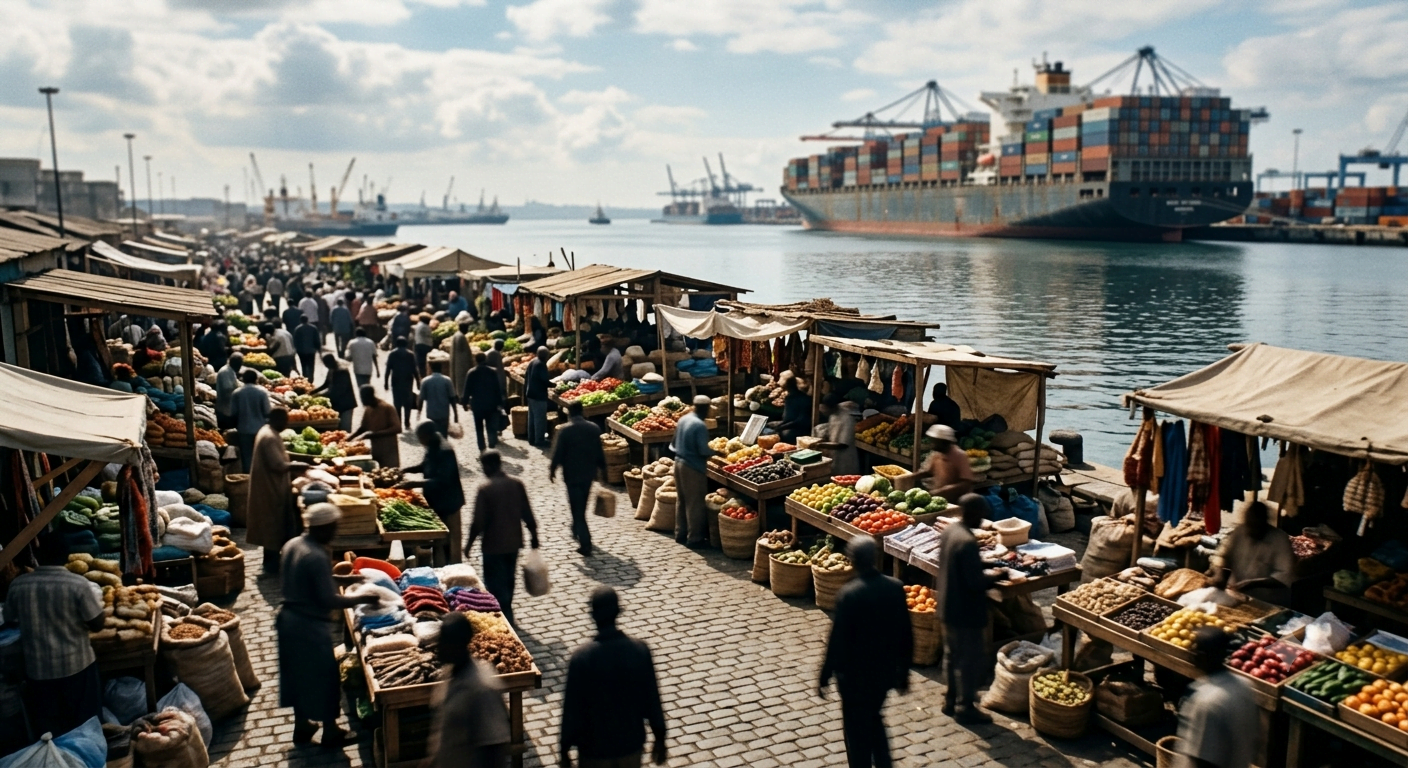
Eamonn Butler: The growth and extent of world trade today is staggering. In 1950, trade accounted for just 8.6% of world output (GDP). By 1980, it was nearly double that, and by 2008, over triple. Within twenty years, trade accounted for an astonishing 60% of world GDP, involving $20 trillion in goods and over $5 trillion in services. Despite inevitable temporary setbacks (financial crises, civil wars, international wars, trade wars, even pandemics) trade seems set to continue its long-term expansion. And with expanding trade has come globalization — the interaction and integration between the world’s peoples, companies, and economies, bringing rising prosperity and the spread of ideas, cultures, and progress.
If trade is so beneficial and has proved successful in helping many nations lift themselves up from poverty, why does it have so many opponents today?
Eamonn Butler: There is no progress without change, but change creates both winners and losers. People in wealthier countries, for example, complain that cheaper foreign workers are taking their jobs, while poorer countries worry that traditional crafts are being driven out by mass-produced imports. But it makes no sense for a country to make at home what it can buy the same or better more cheaply from others. By specializing, every country improves its productivity and long-term prospects. The competition brought by trade is the spur for this progress. Critics also fret that richer countries may dominate trade and leave others behind, that poorer workers are exploited in ‘sweatshop’ conditions, or that cultures are being swamped because of trade. In reality, trade has delivered, particularly to the world’s poorest, history’s biggest and fastest rise in prosperity.
——— Related: Johan Norberg on progress and globalization ———
Why does free trade remain a distant dream in much of the world today?
Eamonn Butler: The pressure from producers who are threatened by cheaper or better goods from abroad leads many countries to put up barriers against foreign competitors. Some may want to make themselves self-sufficient, resisting cheaper imports until their own industries grow large enough to compete. They may accuse others of ‘dumping’ cheap goods on them, undermining their own producers. They may object to imports from countries that do not share their own high employment or environmental standards. They may be worried that they are spending more on buying goods from other countries than those others buy from them.
The Myths and Realities of Trade Policy
Trump made the term “trade deficit” popular. In what way is a trade deficit significant?
Eamonn Butler: If a country’s imports and payments are bigger than its exports and receipts, we say it is running a deficit. That is a problem for its politicians since a country that is not paying its way looks weak. Worse, it might have to dip into reserves (the country’s savings) or rack up debts in order to cover the shortfall. Having said that, countries routinely run deficits with some countries and surpluses with others. As long as you’re not overspending in total, that’s fine.
What should be a government policy in a free society regarding international trade? Is there a “one-size-fits-all” solution?
Eamonn Butler: Sadly, most policy on trade is driven not by economic logic but by domestic and international politics. That is why trade needs an international framework and a global rule of law to work well. This is no easy task, given the many pressures on countries to protect their own industries and raise barriers against others. But we have no way of knowing where trade will take us in the future: our best policy is not to resist change, but to help those affected to adapt to it.
Trade, Change, and Economic Disruption
What about the losers that free trade produces? How do we internalize the exorbitant cost driven by free trade?
Eamonn Butler: Economic change is a constant process. Candlemakers were put out of business by gaslights, livery stables by motor vehicles, typesetters by computers, and many shops by online retailers. Artificial intelligence will revolutionize yet more industries. But despite the disruption brought for some, such progress delivers huge improvements to the lives of the general public, which is the whole purpose of production in the first place. Trade simply accelerates this inevitable and beneficial process. If we want to help the losers, the best thing is to help them become adaptable and develop new production strategies that are more relevant to modern needs — not simply to throw them subsidies that keep existing outdated industries going.
—— Related: Art Carden on the origins of modern prosperity ——
What about the increased carbon footprint exacerbated by free trade? Don’t free traders care about the environment?
Eamonn Butler: The environmental costs of transportation are lower than imagined. Containerisation and computer logistics allow goods to be shipped in bulk with amazing efficiency. Indeed, most ‘food miles’ are the last mile between the shop and the customer’s home. And in cold climates, the ‘buy local’ alternative of raising crops and animals locally would require more energy than importing them from warm climates. So it is wrong to condemn trade as wholly destructive to the environment. And WTO agreements do take environmental concerns on board. The real task is to organize trade such that we protect the environment while still advancing human progress, particularly for the poorest.
——— Related: Weiss & Barnard on market environmentalism ———
We have heard about the economic case for free trade. What about the moral case? Is there one?
Eamonn Butler: Globalization has seen an increase in tolerance, precisely because of the benefits that trade brings to individuals, groups, and countries who may not otherwise agree on much. Trade systematically drives out discrimination based on nationality, ethnicity, color, gender, sexual orientation, caste, and everything else — since those who refuse to deal with others on such economically irrelevant grounds do not get the full benefits of truly global trade. For example, the rapid expansion of world trade since the 1980s has spread tolerance for different lifestyles. It has also contributed to a rise in the status of women, particularly young women, to a far greater extent than other possible factors, such as democracy. And with that, trade has improved female life expectancy, literacy, and gender equality. On these measures, there can be little doubt that trade is a force for good.
What is the future of (free) trade?
Eamonn Butler: There are lots of issues to address. One is a rising focus on security — should we import Chinese technology, for example, that might be used to spy on us? Another is the spread of counterfeit and pirated goods, including clothes and shoes, electronics, perfumes, toys, and medicines. A growing part of trade is now services, such as banking, accountancy, legal services, healthcare, education, digital services, and telecommunications, raising issues of their own as well as the general question of whether the qualifications of the relevant professionals (such as lawyers and accountants) should be accepted internationally. And more generally, the growth of ‘emerging’ economies (such as Brazil, China, India, Indonesia, Mexico, Morocco, the Philippines, South Africa, and Turkey) is tilting the traditional economic balances between regions across the globe. But with nearly all countries now WTO members, all these are being addressed.
Finally, although not directly related to the general topic of today’s conversation, I would like to end my interviews with this: How to find freedom in an unfree world?
Eamonn Butler: Hayek put it best: “We must make the building of a free society once more an intellectual adventure, a deed of courage. What we lack is a liberal Utopia, a program which seems neither a mere defense of things as they are nor a diluted kind of socialism, but a truly liberal radicalism which does spare the susceptibilities of the mighty (including the trade unions), which is not too severely practical and which does not confine itself to what appears today as politically possible… if we can regain that belief in power of ideas which was the mark of liberalism at its best, the battle is not lost.”
This interview first appeared in Austrian Economics Center.