What do graphic novels, political documentaries, and Georgian winemaking have in common? For Matt Battaglia, they are all ways of exploring the human experience and the meaning of freedom. In this interview, we discuss artistic expression, political propaganda, storytelling, digital gatekeepers, and how creators can reach audiences without sacrificing their vision.
About the Guest
Matt Battaglia is the executive producer at Free the People, where he directs and produces documentaries exploring political and social issues through individual stories. His work includes the award-winning documentaries Off the Grid, All We Have, and The Free Life, as well as The Red Line. Alongside his film work, Battaglia is a comic book creator whose publications include Ghosts of the Carousel and the graphic novel House on Fire. His work spans documentary filmmaking, comics, and visual storytelling.
Interview
Simon Sarevski: Let’s start with House on Fire. You began working on it in 2020, in the middle of COVID. What made you choose a graphic novel to explore that period rather than a political book, essay, or documentary?
Matt Battaglia: Comics are my preferred personal art form, so it was a natural choice for the personal nature of that story. I think the route that I went with the story made for a more lasting work. Whereas, political books (beyond being not remotely in my interest), essays, and even documentaries on the subject of COVID are all easily lost to time. At Free the People we did produce a few documentaries around the COVID experience. In particular, All We Have, which I directed, and while I am proud of that film, I think it’s locked into that time and place in a way that House on Fire isn’t.
If a reader didn’t know when House on Fire was written, they might not immediately connect the story to the pandemic. Why did you choose not to make that connection more explicit, instead leaving the world — and what happened — open to interpretation?
Matt Battaglia: I intended for the work to be interpretive; at the time of release it was maybe more clearly a reaction to COVID, but I think making that explicit connection would have forced a certain reading onto it. I view art as a collaboration between artist and the (in this case) reader. I don’t want to walk into making something and try to force someone to view it only one way. House on Fire means something to me, and I hope it means something to someone else – but I don’t expect the two meanings to be the same. I wasn’t trying to convince anyone of anything with the book, I just wanted to provide something of an emotional release for the anxiety of that time period.
You’ve worked across comics, documentaries, advertising, and political media. What makes a story worth telling for you?
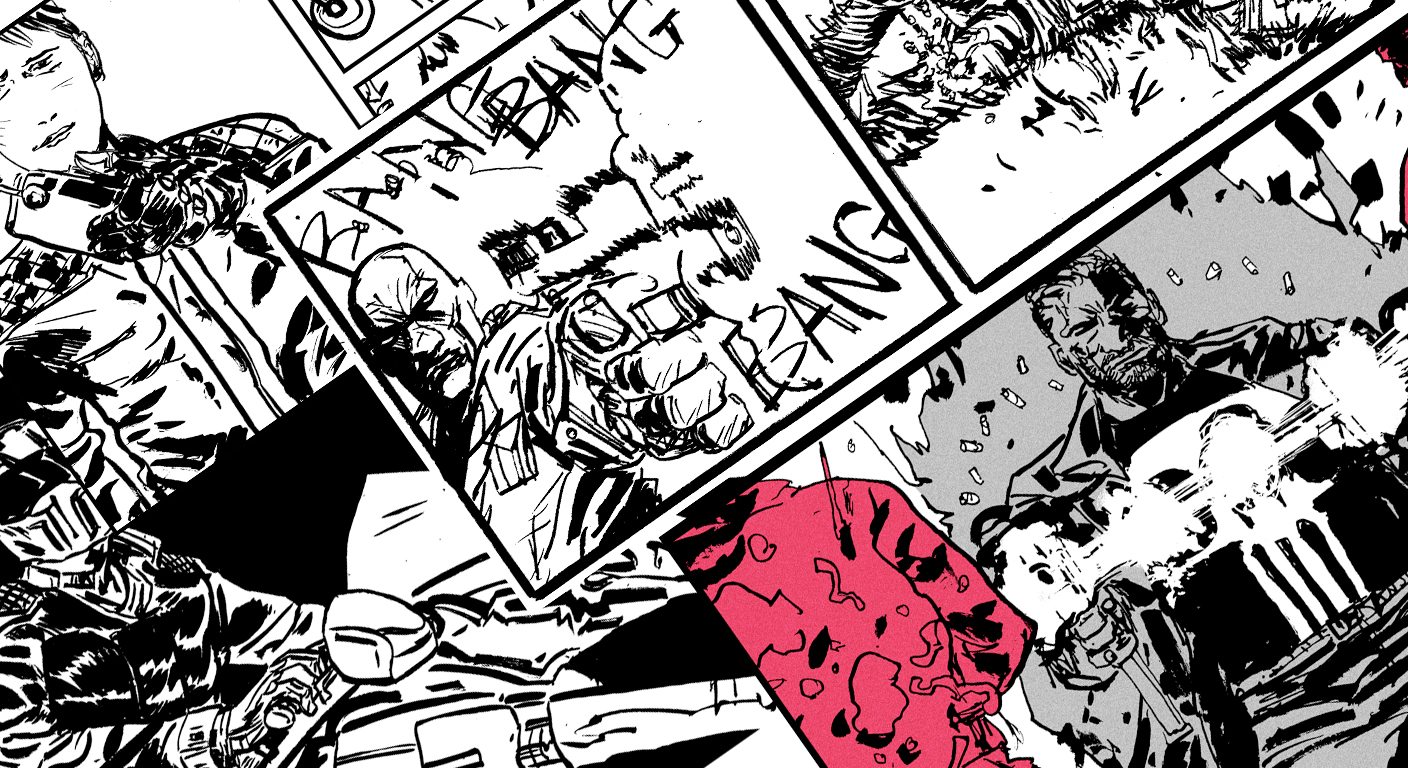
Matt Battaglia: I ask if it reflects something fundamental about being human and living. That’s my goal. Whether that is in documentary or genre fiction, I want to make work that, hopefully, gives people insight into another person’s life and emotions or their own. Although, on the other hand, sometimes I just want to make something that’s fun and cathartic (see my Bootleg Punisher comic).
When you have an idea for a story, how do you know whether it belongs in fiction or documentary—and which gives you more freedom to tell the truth?
Matt Battaglia: It’s very easy to decide what’s a documentary in that you have to have a real subject and a real story to tell. Where I work at, Free the People, we do a fair amount of documentary because it’s a powerful way to show problems and solutions through the eyes of a real person’s life and experiences.
Anything that I do as a comic is me chasing my muse basically.
In The Red Line, you explore Georgian winemaking and the revival of traditions disrupted under Soviet rule. Can preserving or recovering a tradition itself be an act of freedom?
Matt Battaglia: Yes, particularly in this case, as it was stripped from the people by the Soviets. We also recently completed a feature-length version of this film, which I’m excited to be able to get out in front of people soon.
What can artistic freedom demand from the person pursuing it?
Matt Battaglia: For Carlos Luna, the subject of The Free Life, it demanded he leave his home and his family in order to pursue his art and to be free. With any artistic endeavor, there’s some risk – obviously, with blatantly “political” art, those risks can be higher. However, when creating personal works, you risk a level of vulnerability in front of an audience; there’s a risk of failure or denial.
Across these projects, you repeatedly approach large political and social questions through individual people and their stories rather than through abstract arguments. What can a person’s story reveal—and perhaps persuade us of—that statistics and political arguments cannot?
Matt Battaglia: I would make a note that all these documentary projects are produced for Free the People and are the work of a team, of which I’m a member. Documentary and film projects are (rarely) a one-man show (like comics can be). That said, at Free the People it’s a deliberate choice for our projects to approach political and social questions through smaller frames as it makes the problems and their solutions more personal and real to the audience. Textbook theory has its place and it can be bolstered and made more readily digestible by showing principles through narrative.
——— Related: Bosko Karajov on Nozick and Spider-Man ———
That also creates a danger: once art is trying to communicate an idea, the message can overwhelm the story. When does political art become propaganda?
Matt Battaglia: To me, the line is when you walk into the story trying to convince someone of something – or worse still, to trick them into thinking something. My goal for anything I work on that has any kind of theme to it is not to walk into it with a message to convey. The goal is always to just approach with curiosity and a desire to capture things as they are, present that to people, and let them make a choice on what to think. Where much of “politically charged” work fails, for me, is when that ‘message’ is so top of mind that it’s text rather than subtext.
— Related: Sean Malone on heroes, villains, and popular culture —
Has technology made it easier for creators to bypass traditional gatekeepers—publishers, studios, broadcasters—and reach an audience directly?
Matt Battaglia: Certainly, it’s so much easier to publish – however, that doesn’t mean you’ll ever find an audience, but that wasn’t a given in the old paradigm either.
At the same time, platforms and algorithms increasingly determine what people see. Have we escaped the old gatekeepers, or simply created new ones?
Matt Battaglia: We’ve certainly created new gatekeepers, and it still offers more chance to be discovered by an audience than before. That said, there’s this ever-present pressure that you must constantly be on all these platforms posting in order to maintain or find an audience, so I often worry that people are feeding a beast and not actually getting much out of it. The most rewarding interactions for me as a ‘creator’ are always in-person ones, whether that’s the times I’ve done comic-cons or store signings with my books or film festivals and screenings with the films I’ve worked on.
Is there a story you’ve been wanting to tell but haven’t yet found the right way or opportunity to tell?
Matt Battaglia: I have an ongoing ‘series’ that’s spun off of my Ghosts of the Carousel book – I find myself occasionally adding to it as life changes happen; I’m always kicking around how to make it into a long enough book to do something more with it. On that theme, I also have a Jersey Devil/music/boardwalk book; it’s just right now too big an undertaking from a drawing perspective at the moment. I have a 40+ page first issue of my action comic Crimson Hat that I’ve got mostly written (somewhere) that I’d like to muster the energy to complete. However, right now my goals are to finish my as-yet-untitled Wilderness-Vampire book that’s kind of an erotic thriller. I’m 70+ pages into it, planned for 150, so it’s getting there. I’m also working on a weekly webcomic called Unspeakable, which is getting posted at Free the People’s Substack. I love The Punisher comics and the vigilante genre, and this strip is scratching that itch for me.
And, in what will come as no surprise to regular Strixly readers, how do you find freedom in an unfree world?
Matt Battaglia: That’s a big question… I’m not so sure; I suppose through making art is how I find ‘freedom.’