
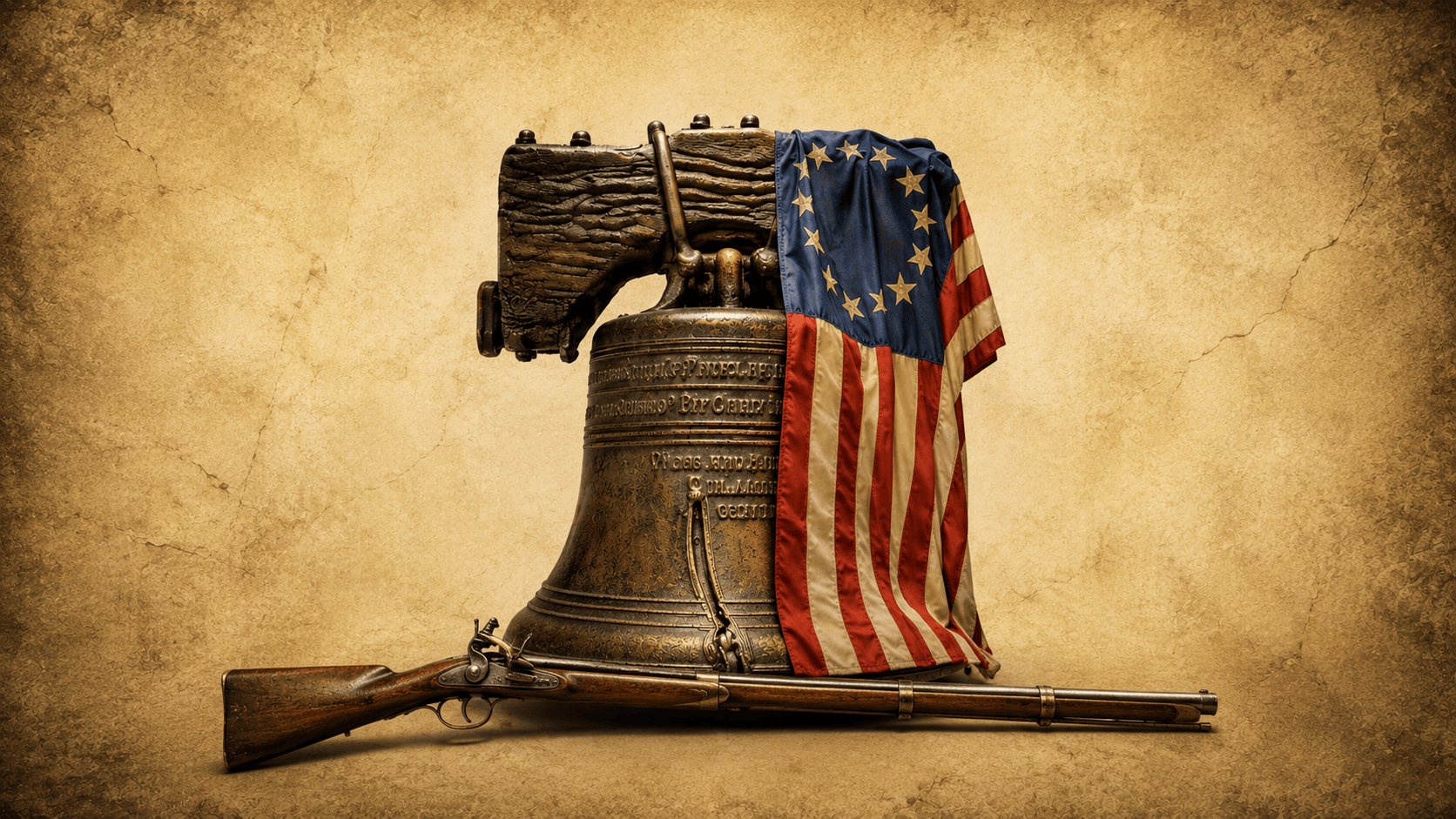
Drawing on themes from Lawrence W. Reed’s latest book, Born of Ideas, this conversation explores America’s founding principles and the complex realities of history, as well as the institutions that shaped the country.
Readers interested in more of Larry Reed’s thoughts can also check out What Does It Take to Be a Hero?, where we discuss the importance of character and moral courage, and the role of personal responsibility in a free society.
About the Guest
Economist and historian Lawrence W. “Larry” Reed is president emeritus, Humphreys Family Senior Fellow, and Ron Manners Global Ambassador for Liberty at the Foundation for Economic Education. He also serves on the board of the Free Society Coalition, where readers can explore the Happy Birthday, Freedom! brochure.
Interview
Simon Sarevski: The American Revolution was obviously a turning point for the colonists. Why should someone in any country today still care about it? What made it a turning point in the history of humanity rather than simply another successful revolution?
Larry Reed: Though history records hundreds of revolutions that failed and a few that succeeded, the one that took place in America was the first to proclaim certain profound principles that are universal—all men are created equal, human rights come from “nature and nature’s God” and not the government, the purpose of government is to protect life, rights, and property, and that people have every right to get rid of any government that doesn’t do its job.
Of course, America’s founders compromised on some issues for the sake of union — most notably, slavery. But they put ideas and institutions in place that would enable future generations to complete the venture they courageously started. They moved the needle toward individual liberty further than any society in the previous 2,000 years.
As the title of your latest book argues, America was “born of ideas.” What exactly were those ideas, and why do they matter more than ancestry, ethnicity, or even geography?
Larry Reed: The most important ones I’ve cited in my previous answer. The very fact that they were the primary motivators of the Revolution is itself a departure from most of history. In more revolutions than I can count, the factors of ancestry, ethnicity, and geography played a larger and far less lofty role than good ideas. Often, people revolted because they wanted to grab power, seize land, punish people they didn’t like, or change borders. Because the idea of liberty took a back seat (if it was a factor at all), those revolutions resulted in new tyrannies and oppressions.
Take the big three, for example, the French, the Bolshevik, and the American Revolutions. All championed “power to the people” in one way or another, but only the American Revolution delivered it.
Under the influence of Enlightenment thinkers like John Locke and David Hume, and Great Awakening preachers like George Whitefield and John Wesley, Americans by 1776 had come to appreciate the individual. Liberty only makes sense in the context in which we are all created—each one his own unique entity who cannot achieve his potential without the freedom to be who he is and to make his own choices. In centuries past, people were treated like they were interchangeable parts of a giant blob that belonged to whoever held political power.
The men and women of 1776 also elevated personal character. Indeed, our Founders frequently said that without it, a free society will fail. They championed virtue as an end in itself. That’s a big reason that, unlike the French and Bolshevik experiences, the American Revolution did not produce rivers of blood or slaughter on a genocidal scale. We had no thugs like Robespierre or Lenin.
Most countries are nation-states built around a people, a language, geography or all of them combined. American identity seems different. What actually makes someone an American?
Larry Reed: Unfortunately, to be an American meant more in our past than it has come to mean in recent decades. Politicians in search of votes have watered it down to mean little more than simply living within our borders, even if you crossed them illegally.
To really be an American in the traditional sense is that you believe in the country’s founding ideal of liberty, of “live and let live” as we used to say. It meant you came here not to claim material benefits or to seek political power but to live free as productive citizens. It means you join the melting pot; you don’t seek to impose on other Americans the bad habits and destructive politics you left behind.
The phrase “American exceptionalism” is often used politically but rarely defined. What did it originally mean, and is there still something genuinely exceptional about America today?
Larry Reed: America is still an exceptional country, in large measure because of our founding ideals that most people here still hold dear. If we ever forsake those ideals for stupid ideologies like socialism, we won’t be exceptional anymore; we’ll simply become another of the thousands of forgettable hellholes that blight the planet’s history.
I’m happy to tell your readers that I have a new book coming out this summer that deals with this subject. It’s called Born of Ideas: How Principles, Faith, and Courage Forged America. It’s available for pre-order now on Amazon. You can also order the small book I wrote a few months ago, titled I, Smartphone: Far Smarter Than You Ever Imagined.
——— Related: Scott Nelson on the meaning of liberty ———
America has always fallen short of its own ideals—slavery, segregation, discrimination, and much more. How should we judge a country that proclaims universal liberty while repeatedly failing to live up to it?
Larry Reed: You should judge a country by a) Does it even have ideals worth working for in the first place; and b) Has it made progress over the decades?
Few countries have ever embraced the lofty ideals America did in 1776, and most of those that did were inspired by our Declaration of Independence. Our Founders knew we fell short of some of the ideals we proclaimed, but they gave us the inspiration to complete and perfect the project. Where is the country that never had slavery or some form of discrimination and segregation, or other reprehensible flaws? America is not exceptional because we had such shortcomings, but because of the lengths to which we have gone to get rid of them.
We must have done something right because millions the world over are trying to get here.
My impression is that America is no longer uniquely free. Government has expanded, regulation has grown, and red tape has made opportunity less accessible. Am I wrong? Is America still, in a meaningful sense, the land of opportunity?
Larry Reed: You are correct — government in America is too big, too corrupt, too ineffective, too inefficient, too meddlesome, and too harmful. Jefferson warned us of the tendency for government to grow and for liberty to retreat. Benjamin Franklin famously said the Founders gave Americans “a republic, if you can keep it.” I don’t believe either the Declaration of Independence or the Constitution have failed us; if anything, we are in the process of failing them.
Take education, for example. Our government (or “public”) schools rarely teach real history, individual liberty, free enterprise, or personal character. Parents often value the “free” babysitting service more than what the schools are actually teaching. The teachers themselves have been so indoctrinated they don’t even realize how one-sided they are. Franklin warned us that “the price of freedom is eternal vigilance,” but half of America just wants freebies the government seizes from other people’s pockets.
Compared to most of the world, America is still a land of opportunity. The freedoms we still have are remarkably innovative and can sometimes work their way around the impositions of overbearing government. But Americans who are awake to the dangers, such as my colleagues at the Foundation for Economic Education and other similar organizations, are sounding the alarm. Freedom is never automatic or guaranteed. You can vote it away. So, reminding Americans of what they risk losing is worth every penny and every ounce of strength and persuasion we can muster.
Political polarization often makes it seem as though Americans no longer agree on the principles that once united them. Is today’s conflict mainly about policy, or does it reflect a deeper disagreement over the country’s founding ideals?
Larry Reed: Some of this polarization is hyped up because of the 24/7 news cycle of the modern age. We’re drowning in media and information, so it often seems like we have more polarization than we do. And polarization is nothing new. We had more of it during the Civil War. Even the Revolution had its own civil war within a war: American patriots fought British loyalists in every town and state.
Another, less benign source of today’s polarization is the size and scope of government. When it’s small, it’s not worth fighting over. The bigger it gets, the more corrupt and intrusive it becomes. Big government naturally polarizes people because everybody either fights to keep it off their backs or fights to get in charge of it so they can grab something that doesn’t belong to them. Good government and big government are mutually exclusive.
Demagogues are also on the rise, both in number and in the depths to which they’ll sink to deceive people. This is a sign of the erosion of personal character the Founders warned against. Look at the avowed socialists who are winning elections these days: They tend to be unaccomplished people, full of anger and hate, ignorant of human nature and economics, quick to lie and even quicker to vilify and steal, and eager to plan the lives of others from their parents’ basement or their protected perches in rotten academia. Ayn Rand would call them the “destroyers” in our midst. They are the barbarians who would set mankind back centuries while proclaiming their “good intentions.” Barbarians never care for the ideals of their country.
—— Related: Nikos Sotirakopoulos on the future of liberalism ——
Looking back over 250 years, are today’s challenges fundamentally different from those America has overcome before, or do we simply have a shorter historical memory?
Larry Reed: It’s hard to imagine challenges tougher than winning our independence against the odds, surviving a Civil War, or defeating Nazi socialism or Cold War communism. So, we should be careful not to overstate present dangers or to underestimate our resourcefulness to overcome and prevail.
Nonetheless, we know from historical experience that freedom is not the common lot of humanity. Most people who have ever lived were serfs, slaves, or subjects who lived in fear of political power. Freedom is fragile, rare, easily lost and painstakingly regained. There is nothing about it that is either automatic or guaranteed. If we can be bought and paid for by vote-buying politicians, then we can kiss our freedoms goodbye. If we really want to keep our freedoms and pass them on so our grandchildren can enjoy them too, each of us needs to assess his situation by asking these questions: a) Am I contributing to the problem by my poor example, by my apathy, or by my active endorsement of destructive ideas? and b) What am I doing to preserve and strengthen freedom, or am I just a worthless bystander?
Some societies rediscover unity only after periods of profound crisis—whether war, economic depression, a pandemic, or other national upheavals. Must great nations endure great hardship to renew themselves, or can America recover confidence without catastrophe?
Larry Reed: Bad ideas and bad policies do have bad consequences. I doubt there are painless ways to recover from decades of stupidity and harm. Sometimes we have to “take our medicine” before we learn. I suspect that some form of crisis may be inevitable before we embrace the necessary solutions. But freedom is more than just the desired end; it is also a soothing balm that makes the pain briefer and more tolerable. Think of the places after World War II that jumped quickly from socialist despair to capitalist success, like Japan, West Germany, Hong Kong, or New Zealand in the 1980s.
The renewal of a faltering society may or may not require a crisis, but this much is self-evident: The ideas of the people determine their course. If they shake off the bad ideas and embrace good ones, they can renew and prosper. Ideas matter. As Victor Hugo once said, they are “more powerful than all the armies of the world.” So, I implore my friends in the liberty movement: Work hard, never give up, and remain optimistic.
Has American prosperity made the country more complacent—less willing to take risks and pursue ambition? Is success itself an obstacle to future greatness, or is that the wrong interpretation of what’s happening?
Larry Reed: The Austrian economist Joseph Schumpeter warned that capitalism, or freedom more broadly, could fall victim to its own success. People could succumb, for example, to complacency or envy. They might take their prosperity for granted and then lose it in a delirium of short-term thinking and dead-end redistribution schemes.
There is some truth to what Schumpeter said, but because I believe people are creatures of ideas, I don’t think it’s inevitable. If we recognize what we’re doing to ourselves, we can change course. If I didn’t think so, I wouldn’t have devoted my life to educating people. Success can be an obstacle to future greatness only if you let your guard down or take it for granted. Personally, I find the ideas of liberty so inspiring that I never get tired of them, nor do I let the fruits of success be an excuse to become lazy and indifferent.
If America’s defining asset has always been its ideas rather than its resources or military power, which one of those founding ideas do you most hope Americans rediscover?
Larry Reed: Personal character. That’s where a true renaissance can change everything for the better. It’s so crucial that everything flows from it. No nation ever lost its character and kept its liberties, so if we don’t get character right, not much else matters. Our founders believed that immoral people are not fit for liberty. They were 100% right about that. So read biographies of great men and women of solid character. Make truth, honesty, responsibility, courage, patience, and gratitude priorities in your life. You’ll be amazed at the doors these virtues will open for you, and you’ll be doing your part to strengthen freedom at the same time.
Does America remain in any meaningful sense America if it ceases to believe in the ideas that gave birth to it?
Larry Reed: No. If Americans ever reject the ideas that made the country exceptional, history will toss it into its dumpster where thousands of other defunct tyrannies languish.
You’ve given countless interviews, speeches, and Q&A sessions over the years. What’s one question about America, liberty, or your own work that people rarely ask you—but should?
Larry Reed: Now, that’s a tough one. Let me be a little self-serving here and say I wish people would ask, “Do you have a website?” I do indeed, but I rarely am asked about it. Yet, I’ve posted—mostly in the blog section—hundreds, maybe thousands, of articles I’ve written over the years. It’s got a good search engine and an AI-driven “Ask Larry” function. The site is at www.lawrencewreed.com.
Since you’re an avid reader, what’s something you’ve read since our last interview that has really stayed with you or challenged your thinking?
Larry Reed:Gordon S. Wood is one of my all-time favorite historians. He wrote so many excellent books, mostly on the American Revolution era. I was taken aback by his untimely death in a parking lot accident in early June 2026. So as a tribute to him, I read one of his books I hadn’t read before, Revolutionary Characters: What Made the Founders Different.
Every chapter is a brilliant and entertaining profile of an extraordinary Revolutionary patriot — George Washington, Benjamin Franklin, Thomas Jefferson, James Madison, Thomas Paine, and more. So many stories and anecdotes are vividly memorable. Any reader anywhere will likely enjoy it immensely.