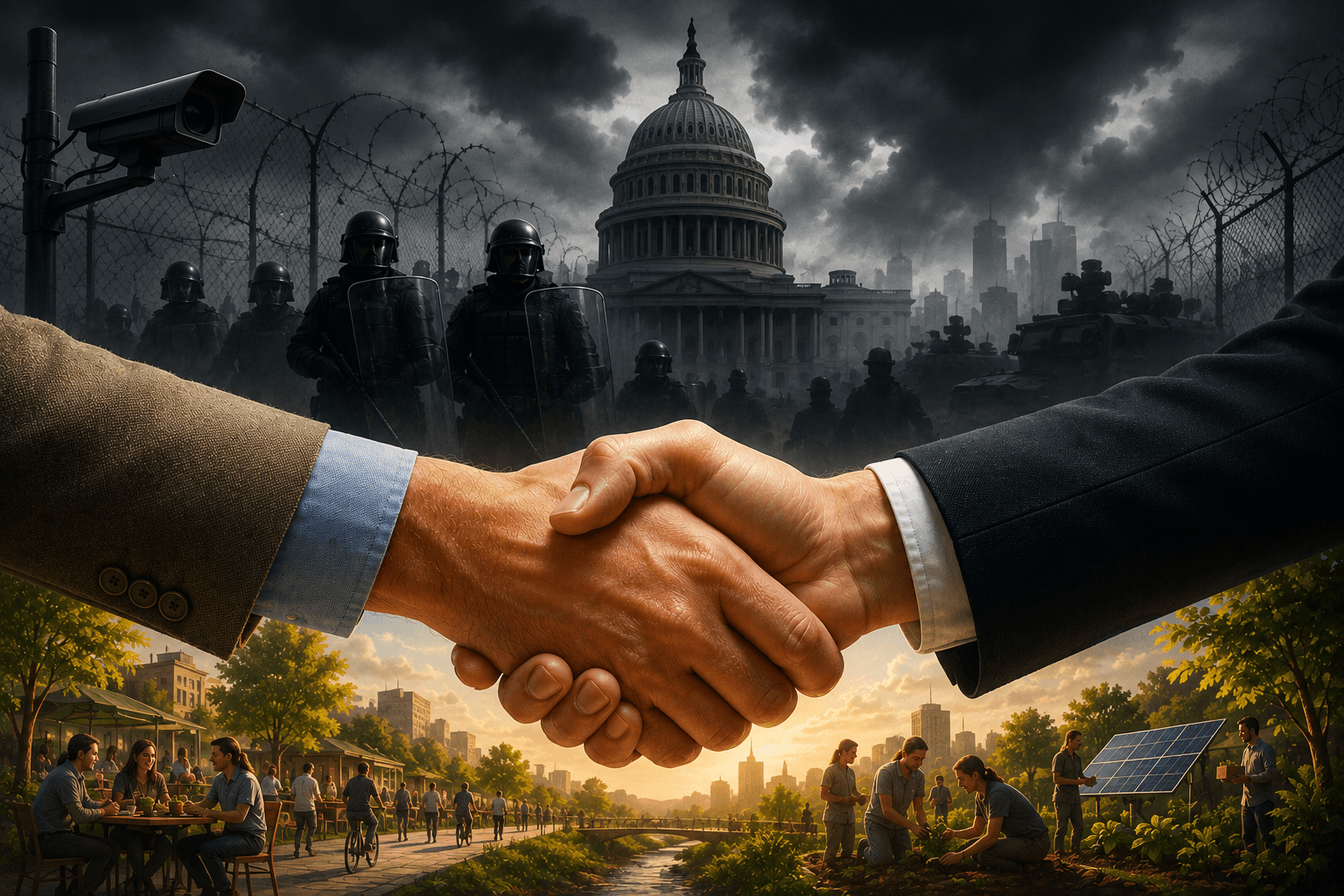
In this interview with Antony Davies and James Harrigan, we explore cooperation and coercion, and the scope and limits of politics in shaping a free society. What can politics realistically achieve as a tool for solving social and economic problems, and where does its influence end?
About the Guests
Antony Davies is an economist, author, and former professor who currently works in the financial industry. He has written books and hundreds of op-eds, produced videos, and recorded podcast episodes on economics and public policy. You can follow him on X at @antonydavies.
James R. Harrigan is a writer and commentator on political economy and public policy, and a former professor. He serves as COO of Polyhymnia. He has written extensively for the popular press. You can follow him on X at @JamesRHarrigan.
Together, they co-author Cooperation and Coercion and co-host the podcast Words & Numbers, where they explore economic reasoning and public policy through accessible, often counterintuitive discussions.
Interview
Simon Sarevski: Your book argues that cooperation—not coercion—is the foundation of prosperity and civilization. But real life throws political and economic curveballs at us: wars, pandemics, natural disasters, supply shocks. In moments like these, where are the limits of voluntary cooperation, and where—if anywhere—does coercion become justified?
Antony Davies: Not quite, and our title gives the clue. We didn’t title it, “Cooperation or Coercion,” but “Cooperation and Coercion.” Coercion is sometimes necessary. That’s how we prevent one person from stepping on the rights of another. If I open a restaurant and you choose to eat there or choose not to eat there, whether we do or do not exchange money for services is wholly a matter of cooperation. Now, if I force you to eat at my restaurant – perhaps by shutting down all competing alternatives, or by co-opting the government to require you to pay for meals – that’s coercion and clearly a problem. However, if you dine and dash, I can chase after you and restrain you until you pay or, more likely, call the cops and have them haul you before a judge, and he will make you pay. This is also coercion, but it’s coercion to rectify a rights violation.
The whole point of government is to be an instrument of coercion. Good government uses coercion to prevent people from violating others’ rights and to force recompense when they do. Bad government uses coercion to violate people’s rights. All governments are a mix of the two. Constitutional republics are among the least bad solutions we’ve devised for pushing that mix as far as possible in the “good” direction.
James R. Harrigan: I’ll answer your question a little more directly. You ask what the limits of voluntary cooperation are and offer things like wars, pandemics, and natural disasters in your question as possible problems. Indeed, they are. What we find is that voluntary cooperation often breaks down, and when it does, coercion becomes justified under certain circumstances.
With war, I think the answer is relatively straightforward. There is a tremendous difference between offensive and defensive wars. Both might be necessary, but there is always a difference. True coercion in time of war is best exemplified by a military draft. And a military draft requires an existential threat to be reasonable. It is without question a form of servitude. But there are times, like World War II, where a condition of servitude can be argued to be wholly acceptable. The Vietnam War, I think, presents a perfect counterexample.
Pandemics, I think, are an easy call. If we are experiencing an actual pandemic that runs the risk of killing a good number of us, government coercion is warranted. Imagine, if you would, a disease that we know for a fact would kill 8 of every 10 people infected. Is there any reasonable case against mandatory vaccination? But the recent pandemic we experienced didn’t fit this description. Was the level of government intervention warranted? I don’t think it was.
With natural disasters, I think government intervention is almost always deeply problematic. That doesn’t mean we shouldn’t have government intervention. It does mean that we shouldn’t have things like anti-price gouging laws that very typically come with natural disasters in the United States.
The question that we always have to ask is whether government coercion does more harm than good. It’s almost always the case that it does, but it’s only almost always the case. It’s not never the case.
When problems arise, people look to government for solutions. What are the things government can realistically do well—and what are the things markets, communities, and civil society tend to do better?
Antony Davies: What government does better than society changes based on circumstances. Before the United States expanded into the western territories, people had to come up with their own rules and look to themselves for enforcement. Government was simply too distant to handle that well. As settlements grew, and transportation and communication became better, government got good enough to take over the rule-making and enforcing. As people become more peaceable, information becomes less costly to obtain and more trustworthy, we see a movement in the other direction. Homeowners associations, private security, and arbitration start to replace government. Government remains in the background, but becomes a fall-back rather than a go-to.
Given that the answer changes over time, rather than ask what can government do well, we should simply default to relying on non-government solutions first and only invoking government when it’s clear that non-government solutions can’t handle the problem.
James R. Harrigan: I agree with Ant fully here. The first question that should always be asked is, “Can we do this ourselves?” And if we can, government shouldn’t be involved.
What’s an example from our recent past of a problem where government intervention genuinely improved people’s lives—and one where it clearly made things worse?
Antony Davies: DUI laws are a good example. We do not wait for a drunk driver to kill someone and then try to make the victim’s family whole. That’s impossible. So, we ask the government to intervene before the harm occurs. Notice that this isn’t something society will handle well because DUI isn’t a violation of anyone’s rights. It’s the accident caused by the DUI that is the violation.
A clear example of government making things worse was the COVID lockdown. Early fear was understandable. Early uncertainty was real. But the incentives were terrible. A politician who failed to lock down and saw bodies pile up would be blamed. A politician who locked down unnecessarily could always point to hypothetical deaths and say, “Imagine how bad it would have been.” That is a perfect recipe for overreaction.
And the overreaction was not costless. Small businesses closed. Children lost schooling. People delayed medical care, succumbed to addictions, despaired in loneliness. The burden fell hardest on people least able to bear it. That is the basic problem with coercion: once government starts pushing, the people with the least political power tend to get pushed hardest.
James R. Harrigan: It’s hard to come up with better answers than Ant has here, but I will offer the tragedy of the commons as something that only government could address. We get clean air and clean water not because corporations are virtuous and would not pollute because that’s the right thing to do, but because government enforces consistent rules requiring non-pollution. The market really can’t handle this. Only government can.
The other side of the coin is, I think, a lot easier. Public education is a perfect example. There can be little doubt that public education in the United States is a bit of a disaster. But it’s a disaster that has the full power of the state and federal governments behind it, which makes it almost impossible to undo. We see meaningful pushback from the homeschooling movement and from charter schools. But it’s really a drop in the bucket at this point. We can only hope that that one drop turns to two and the two turns to four and so on and so forth.
But for now, I think when we look at public education, all we can see really are problems.
James, you end the podcast by saying: “Try to be nice to each other.” With political polarization rising and people increasingly living online rather than in local communities, are we becoming less tolerant and less cooperative—or does modern media simply magnify the worst behavior?
James R. Harrigan: It’s pretty clear that online behavior and in-person behavior are radically different. I often say that when people knew that a punch in the mouth was a very possible outcome to certain things they could say or do, people behaved much better. I will carry that belief to my grave, but generally people are inclined to be nice or indifferent towards one another. I’m just trying to get them to be less indifferent, really. And I’m trying to get them to think twice before they say something horrible online that they and everybody else will regret down the road.
This happens to all of us. We see something that’s angering, to say the least, and our fingers go right for the keyboard. But it’s probably best to take a deep breath and then write something, and then let it sit there for a minute and reconsider whether you’re going to hit the enter button to post it. Because most people wouldn’t dream of saying things in person that they routinely say online. And that’s a real problem. And it’s a problem that needs to be pointed out when seen.
So when I say something like, “Remember to be nice to each other,” in any number of its many forms that you’ll hear at the end of the podcast, I’m really getting at this sort of thing. And look, it doesn’t really take much to be kind. Sometimes it’s hard, but it doesn’t take much.
We live in a graceless age. We can and should be better. And if one guy on one podcast reminding people of that from time to time, from week to week, does the trick, then that’s great. Even if it doesn’t work, I’m going to keep saying it.
Social media was envisioned, at least on paper, as a tool to bring us together. Yet in many ways it seems to reward outrage more than cooperation. How do we resist becoming cynical in the social media age?
Antony Davies: Social media rewards outrage for the same reason that the mainstream media rewards outrage – because outrage is useful to the platform. It keeps people watching, posting, arguing, and coming back. The first thing is to remember that social media companies are not communities, and mainstream media companies are not news outlets. Neither is a public square in any meaningful old sense. They are profit-seeking businesses selling attention. Facebook, X, Google, and the rest are not in the friendship business. Fox, MSNBC, etc. are not in the news business. They are all in the advertising business. That is not an argument for government control. It is an argument for adult expectations.
The way to resist cynicism is to spend more time in cooperative life than in performative life. Volunteer, join a church, club, business, neighborhood group, poker game, anything where people must deal with one another as whole human beings rather than as avatars or political categories. The online world makes people look worse than they are because it strips away the ordinary humanizing details.
In 2018, Robert Gregory Bowers killed a number of people at a Pittsburgh Jewish community center. Following the attack, Muslim neighbors offered help and raised over a quarter of a million dollars for victims. An Iranian-American GoFundMe raised another million. At Allegheny General Hospital, Jewish doctors and nurses treated Bowers. These are the things people do in the real world when they are not being sorted by algorithms into tribes.
James R. Harrigan: The thing to remember about social media is that it is not real life. Adults know this for the most part. But children, teenagers, and young adults don’t. And they have to be reminded by those of us who know better what the fact of the matter is.
Why Good Intentions Go Wrong
The “wars on nouns”—the war on poverty, drugs, terror, and so on—are effectively unwinnable. But doesn’t culture change over time? Smoking rates fell dramatically, alcohol consumption has declined in many countries, crime has fallen in many parts of the world. So why do these political “wars” become permanent?
Antony Davies: Japan could surrender. Germany could surrender. Poverty cannot. Drugs cannot. Terror cannot. You can reduce them. You can manage them. You can change the incentives around them. But you cannot gather them on a battleship and have them sign documents.
That matters because war language suspends ordinary judgment. War invites coercion. It lets politicians say that rights must yield to necessity, that costs must be endured, that victory is just around the corner if only we spend more and grant more power to government.
Smoking declined largely because culture changed, information spread, norms shifted, prices changed, and people altered their behavior. That is not the same thing as a war. A war on smoking would have produced enforcement agencies, black markets, forfeiture, surveillance, and probably a few heroic speeches about protecting children.
The wars on poverty, drugs, and terror persist because they have no limiting principle. They create agencies, budgets, constituencies, and moral narratives. And all of those things evolve constituencies who depend on the war continuing. The people who work for the TSA, for example, will lose their livelihoods if the war on terror ends. And because victory is undefined, failure can always be renamed as a reason to continue.
How much of bad policy comes from bad incentives versus genuinely good intentions gone wrong?
Antony Davies: Most bad policies are sold with good intentions. No politician says, “I intend to make poor people worse off, raise college tuition, drive small businesses under, and leave future generations with an impossible debt.” They say they are helping workers, expanding opportunity, protecting children, saving lives, and securing the future. But intentions don’t change incentives. They don’t repeal scarcity. They don’t solve the knowledge problem. They don’t make tradeoffs disappear. And they don’t transform politicians and bureaucrats into angels.
The minimum wage is intended to help low-income workers. It helps some and prices others out of the labor market. And, on average, the ones it helps are more likely to be the ones that would have earned more anyway over time. Student loan forgiveness is intended to relieve debt burdens. But it rewards imprudent borrowing, punishes prudence, and encourages colleges to raise prices. Civil asset forfeiture is intended to fight crime. But it gives law enforcement a direct financial incentive to take property.
How much is due to bad incentives and how much to good intentions gone wrong? That distinction is less useful than it sounds. Good intentions become dangerous precisely when they are attached to bad incentives and coercive power.
James R. Harrigan: I agree with everything Ant says here, but I’ll add just one thing. Each party accuses the other of being evil. But nobody wakes up in the morning and asks, “How can I make children more stupid today?” Everybody has good intentions, but not everybody has good information, and not everybody has the correct impulse to study things before proclaiming judgment on things. Politicians seem to think that whatever they say will just magically happen if they get enough votes on the House and Senate floors. It doesn’t work that way, and every rational person knows it.
—— Related: Dan Mitchell on incentives and economic policy ——
Rights, Liberty, and Political Power
America has gradually moved away from the spirit of classical liberalism—“trading Tom Paine and Thomas Jefferson for FDR,” as you mention in your book. Why do you see that shift as a loss rather than an adaptation? With America turning 250, why shouldn’t someone argue that the original 1776 framework simply isn’t sufficient for a modern technological and AI-driven world?
Antony Davies: In the founding view, a right was a zone of noninterference. It marked off an area where government was not allowed. Life, liberty, property, speech, worship, self-defense, due process—these were not gifts from government. They were limits on government. The modern view increasingly treats rights as claims on other people’s labor and property. A “right” to housing, health care, college, a job, retirement income, or anything else sounds generous. But to say that I have a right to a thing is to say that someone else has a duty to provide it. If cooperation fails to provide it, coercion must. This is something that advocates of positive rights are afraid to examine – because it ends up being an argument for slavery.
If we declare that food is a right, then we have said that it is proper for government to use force to ensure that everyone has food. That sounds magnanimous and just. But suppose there isn’t enough food. What then? We have already agreed that government can use force, so it must use its power to force farmers to grow more. Forced labor is slavery.
A counterargument is that no one is saying that we should force farmers to grow food and, regardless, there’s plenty of food to go around. Yes, right now there is plenty to go around. But that hasn’t always been the case, and there’s nothing to guarantee that it won’t be the case again. As for no one saying we should force farmers to grow food, that’s precisely my point. When you use the word “right,” you are saying that it is good and proper for the government to use force, if necessary, to attain the thing to which you attached that word.
The AI revolution doesn’t make the founding arguments any less relevant than did the internet revolution, the computer revolution, or the industrial revolution. Those revolutions change what surrounds us. They don’t change us. The founding arguments apply to human nature. So long as humans want things. So long as humans are constrained by limitations. So long as humans are different in ability, desire, expectation, and circumstance, the founding arguments apply in full force.
James R. Harrigan: The difference in rights that Ant is addressing here is the difference between positive and negative rights. The United States was founded on a notion of negative rights, natural rights. This means that there are certain things that government, no matter how powerful, cannot do. They’re generally listed in the Bill of Rights, but there are others. The right to property is one of these. And if you look at all of the rights enumerated in the Bill of Rights, none of them cost anything. What does my right to own a firearm cost anybody? What does your right to free speech cost anybody? Now, these rights might irritate people in their exercise, but that’s not an economic cost.
When we consider positive rights, on the other hand, rights to things like food, education, even water, all of these things require some people to provide them for other people. There’s an economic cost to every positive right. This is the critical difference that we need to keep in the front of our minds at all times.
If a right that a politician is talking about costs a lot of money, it’s not a right at all. It’s a privilege, maybe. It’s a gift, maybe. There are a number of ways that we could conceive of this. But rights is not the correct way. We would have done much better had we simply called these positive rights something other than rights when they were introduced in the early part of the 20th century. But of course, the people introducing these sorts of rights, the progressives, wanted to use the language of the American Founding to succeed politically. It was the smart play, but it has done incalculable damage.
——— Related: Larry Reed on the ideas that shaped America ———
How strongly should societies hold to principles like free speech, property rights, or the right to bear arms during periods of fear or crisis? Are principles only real if they survive hard times?
Antony Davies: Government exists for hard times in a very important sense. It exists to protect rights when those rights are threatened. But that is very different from saying government may suspend rights whenever people are afraid. Free speech matters most when people are saying things others find dangerous. Due process matters most when the accused is unpopular. Property rights matter most when others want the property for themselves. The right to bear arms matters most when people are afraid.
James R. Harrigan: Rights can only matter in any meaningful sense when people are willing to defend them even when they disagree with how they are being exercised by other people. When people use government to restrict rights, they do nothing but harm.
What do people misunderstand most about freedom?
Antony Davies: Human beings are social creatures. We find meaning in families, churches, businesses, charities, friendships, neighborhoods, schools, and all the other cooperative associations that make life worth living. Freedom makes genuine community possible. The opposite of government action is not selfish individualism. The opposite of government action is usually voluntary action. People who cannot imagine community without coercion should spend more time looking at actual communities.
A common misunderstanding is that freedom means getting what one wants or doing whatever one pleases. That’s incorrect. To attain freedom, we must embrace equality – the principle that each of us has equal standing within the body politic. That we are all equal means that we must respect each other’s rights to the same extent that we respect our own. Suddenly, freedom doesn’t mean being able to do what one wants. It means being able to do what one wants provided one isn’t violating anyone else’s freedom.
James R. Harrigan: People fail to understand that freedom is difficult. Freedom means living by your own wits a lot of the time. Freedom means that you have the ability to do any number of things. But outcomes are never guaranteed. Freedom is very, very hard for most people. Most people want safety and security. They claim to want freedom, but the minute their personal chips are down, they don’t. Freedom also means that all kinds of things that you don’t like are absolutely going to happen. And you have to let them happen.
People often treat politics like a magic wand—elect the right person and society’s problems disappear. But if the two of you actually had that wand for one day, what would you change immediately?
Antony Davies: There is no change that would be lasting. Ultimately, we get the government we deserve. Any change I would make to the law or the economy or the Constitution or the political process, people would eventually change back. The only lasting change comes from changing the people themselves. But changing the people against their wills violates the principles of freedom and equality. The uncomfortable truth about freedom and equality is that it yields outcomes not all of us like. But a society that respects freedom and equality gives individuals the maximum ability to better themselves within the confines of whatever outcome exists.
James R. Harrigan: Unlike Ant, there are a few things that I would probably try to do. I’ve mentioned this before on the podcast many times, and I’ll mention it here again. I would require a balanced budget, and any budget that was not balanced would result in the legislators voting in favor of it going straight to prison. You would see a balanced budget within minutes.
I would also require anyone running for public office to read the Constitution of the United States in the presence of a constitutional law scholar. There would be a quiz thereafter.
I would also, just for fun, remove the Necessary and Proper and Commerce Clauses from the Constitution.
Should the focus for bettering society be on fixing government institutions, improving economic literacy, strengthening culture and civil society—or something else entirely?
Antony Davies: Economic literacy matters because people need to understand tradeoffs, incentives, scarcity, and unintended consequences. Without that, voters will keep falling for promises that can’t be kept. Culture matters because a free society cannot survive if people use every disagreement as an excuse to coerce one another. Civil society matters because it is where people learn cooperation in the first place. Government institutions matter too, but they are downstream from what people believe government is for. If people believe government exists to give them everything they want, institutional reform will not save us. They will simply rebuild the machinery of coercion in a different shape.
The most important cultural change would be modesty and respect. Modesty: the recognition that none of us knows enough to run everyone else’s life, that evidence matters, and that intentions are not outcomes. Respect: that reasonable people disagree about what constitutes a good life, and both (and neither) can be correct. A society with modesty and respect can govern itself. A society without it will devolve into competing factions using government to bully each other.
Young people today are entering a world shaped by debt, AI disruption, inflation, and uncertainty around pensions and social security. What’s the single most important piece of financial or economic advice you’d give someone entering the workforce today? Is it something as simple as “invest in index funds and ignore the noise” —or does the future require a different mindset?
Antony Davies: That sounds harsher than it is. It is actually liberating. The way to earn more is to make your labor more valuable to other people. The value can arise from education, skills, work experience, discipline, even judgment. It doesn’t have to come from college. Some college majors are excellent investments. Many are financially disastrous.
Young people have been told for decades that college is the key to success. The question isn’t whether college is good. The question is whether this college, at this price, for this student, in this major, is a good investment. Sometimes the answer is yes. Sometimes the answer is no. In terms of financial return, technical training beats around half of college degrees at around half the cost and half the time investment. To those who respond that there’s more to college than a financial return: of course there is. But if you’re asking taxpayers to subsidize the cost, then it’s the financial return that matters because that’s what reflects the return that taxpayers obtain from your education. As for Social Security and pensions, young workers should understand the arithmetic. Promises are not assets. Politicians can promise anything. The laws of mathematics are less accommodating.
Index funds are fine as a tool. They are not a life plan. For most people, the sensible financial path is boring: spend less than you earn, avoid consumer debt, build an emergency cushion, invest regularly, diversify, and ignore people who claim they know what will happen next Tuesday. Broad index funds fit that approach because they are cheap, diversified, and humble. They don’t pretend that you can outguess everyone else in the market.
But the future requires more than a brokerage account. Keep your fixed costs low. Build skills that other people value. Don’t take on unnecessary debt. Don’t confuse consumption with investment. Don’t mistake a political promise for a financial asset. The world will change. It always does. The people who do best aren’t those who predicted the change perfectly. They are those who arranged their lives so they could adapt.
James R. Harrigan: Once again, and not surprisingly, I agree with everything Ant said above. I’ll only add that no matter what point in time you examine, people have always claimed that their situation is both profoundly horrible and unique. It hardly ever is.
The Future of Freedom and Human Progress
Are you ultimately optimistic or pessimistic about AI? Will it expand human freedom and prosperity—or increase centralization and control?
Antony Davies: Very optimistic. I got my first computer when I was in the 9th grade. It was the very beginning of the computer revolution. PCs weren’t yet a thing. The Internet would continue to be science fiction for at least another decade. All the things people are saying about AI now – that it will destroy jobs, take over the world, make people obsolete, etc. – almost verbatim, they said about computers back then. Computers were scary because people had never seen them and attributed to them all sorts of magical abilities. It took a decade or so before people realized that they were simply tools that worked as well or as poorly as the people who wielded them. AI is no different. The counterargument is that “this time it’s different because AI is fundamentally different from what came before.” Yes, those are the exact words people applied to computers when I was in high school. And they used those exact words in describing machines and automation several decades before that.
James R. Harrigan: I am also optimistic, but somewhat less so. AI is grounded on the collected works of humanity. Unfortunately, the collected works of humanity are deeply flawed. They’re also incredibly biased. We don’t typically get truth from AI. We get a reflection of ourselves writ large, and any reflection of humanity will include those flaws.
If cooperation is the key to prosperity and progress, what can ordinary people do in everyday life to make society more cooperative and less coercive?
Antony Davies: Much of modern politics is the refusal to leave peaceful people alone. We see someone doing something we dislike and immediately start looking for a law, regulation, tax, subsidy, ban, mandate, or agency to correct it. Ordinary people can make society more cooperative by building and joining voluntary institutions. Start businesses. Work honestly. Keep promises. Join churches, charities, clubs, neighborhood groups, and professional associations. Help people without first demanding that Congress design a program. Buy from businesses that serve you well. Stop buying from businesses that don’t. Donate to causes that matter. Persuade people. Argue in good faith. Lose arguments graciously. And remember that government is not society. Society is what people build together. Government is the tool we use when we decide someone must be forced. Sometimes force is necessary. But a decent society uses it respectfully and only as a last resort.
A lot of people want to better understand the world they’re living in and how to navigate it—but most aren’t going to sit down and read Adam Smith’s The Wealth of Nations cover to cover. So what are some genuinely readable books you’d recommend to curious people trying to make sense of economics, politics, technology, and human nature today?
Antony Davies: Read F.A. Hayek’s “The Use of Knowledge in Society.” Once you understand the knowledge problem, you will never hear a politician’s five-point plan the same way again. Read “Cooperation and Coercion.” We wrote it for people who want to explore the proper role of government in society and want to see arguments based in both reason and evidence.
James R. Harrigan: I would advise people to read Thomas Paine’s Common Sense and the Declaration of Independence. Both are fantastic political and philosophical documents. They’re also quite easy to read. After that, maybe John Locke’s Second Treatise. But I really wouldn’t push much further down the philosophical line than that.
Harry Browne wrote about finding freedom in an unfree world—but how do James and Ant find freedom in an increasingly unfree world?
James R. Harrigan: Frankly, I would always find a reason to complain about the amount of freedom I experience on a daily basis.
I often asked students a simple question when I would have them in my undergraduate classes. On the first day of class, I would ask, “Think about your average day and tell me the things you do that the government does not regulate in any way.” That’s a much harder question than it first appears to be. Because every single thing that you physically do every day is regulated by at least one level of government and usually by multiple levels of government.
This is true of the air you breathe, the water you drink, the amount of water that can flow from a faucet, the construction of your car, the way you must operate your car, the construction of your house, even how old you have to be to do all kinds of things. Literally everything is regulated somehow, and more regulation equals less freedom. Always. It’s even true of your thoughts when the circumstances line up just right. You might think to yourself, “I don’t like homosexuals.” That makes you a bigot, but you might say you’re free to think that if that’s what you want to think. But the minute you act on it, you’re probably guilty of a hate crime, and you will be charged for two different crimes. So we actually criminalize even your thought.
I would be much happier living in a world that was far less regulated. That doesn’t mean I want to live in a world that’s not regulated at all. Clean water and clean air, two of the things I started with here, are perfectly reasonable things to regulate. We all want and need clean air and water. How much of the rest of it do we really need? I don’t know, which means probably no one else knows fully either. But we should be thinking about that question a lot more than we do.
People’s first reaction to most problems that they perceive is, “There ought to be a law.” Their first reaction should be, “Is this really a problem?” And if it is, “What can we do personally to solve it?“
— Related: Johan Norberg on progress and human flourishing —
Antony Davies: You say increasingly, but it’s not an increasingly unfree world. It’s an increasingly free world. Sure there are setbacks from time to time, but the broad arc of human history is one of increased wealth, increased peace, and increased freedom. Consider: Slavery was simply a way of life for ten thousand years or more. Humans took an institution to which they were addicted for millennia and ended it in a few decades. Yes, it persists in some places, but it is a wisp of a shadow of its former self. Rights of women followed, then rights of children. We have become much more tolerant of people who are different. We have become much more caring for people who are weaker. We have become much more respectful of people who want different things and see the world differently than we do. Do we have more work to do? Of course. But we have come so very, very far in such a very, very short span of time that one cannot but be in awe of how wonderfully humans are progressing.